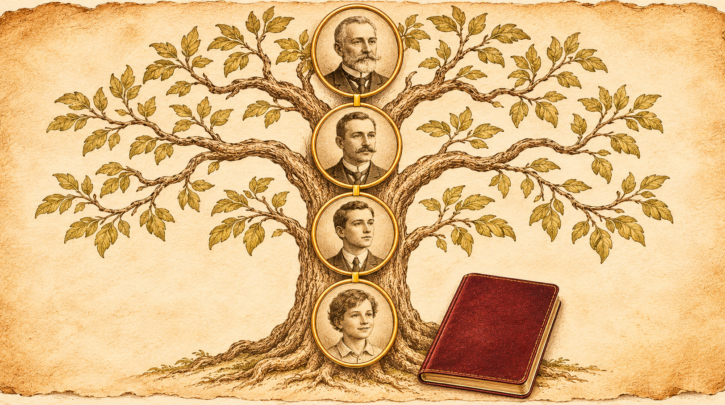

Grandchildren of German emigrants are the most common applicants for German citizenship by descent. Great-grandchildren ask a different, less-answered question: does the chain of citizenship actually survive three full generations, or does it usually break somewhere along the way? The honest answer is that it depends entirely on what happened at each link — not on the number of generations itself.
German descent has no generational cutoff — in theory
Unlike some countries that limit citizenship by descent to one or two generations born abroad, German nationality law (Staatsangehörigkeitsgesetz) does not impose a hard generational limit on descent through an unbroken citizenship chain. If every ancestor in the line held German citizenship at the moment their child was born, that citizenship can theoretically pass down indefinitely. For the full mechanics, see the Complete 2026 Guide.
Does your line go back far enough?
Answer two quick questions to see whether your family line may qualify. Free, and it takes about 30 seconds.
Check my eligibility →Why great-grandchild claims usually fail anyway
The theoretical answer is generous. The practical answer is that three generations gives a claim three separate opportunities to break instead of one or two. The most common failure points, covered in detail in The Broken Chain Problem, are:
- The immigrant ancestor naturalized as a US citizen before their child was born (pre-1904 US naturalization automatically stripped German citizenship under the law in force at the time)
- A child was born out of wedlock to a German father before 1975, when only the mother’s citizenship transmitted automatically
- A German mother’s citizenship didn’t transmit to a child born before 1953 (the pre-equality nationality law only recognized paternal transmission)
- Any ancestor formally renounced German citizenship, which was often a condition of naturalization abroad in earlier decades
Where the §5 declaration and Article 116 fit in
If the break in your chain was specifically caused by the gender-based rules above — a German mother whose citizenship didn’t transmit, or a child born to unmarried parents where only the mother was German — the §5 Declaration exists specifically to repair that category of broken chain, though the window closes 19 August 2031. If the break instead traces to Nazi-era persecution and denaturalization, Article 116 restoration may apply regardless of how many generations have passed since.
What a three-generation documentation package actually requires
Every generation in the chain needs its own proof: birth certificate, marriage certificate (if relevant to legitimacy questions), and evidence of citizenship status at the relevant date — not just proof the person existed. For a great-grandchild claim, that typically means:
- The immigrant ancestor’s German birth/baptism record and proof of citizenship status at emigration
- Proof of the immigrant’s naturalization date in the US (or home country) — this single date is often the whole case
- The grandparent’s birth certificate, showing they were born before or after that naturalization date
- The parent’s birth certificate and the grandparent’s citizenship status at that birth
- Your own birth certificate and the parent’s citizenship status at your birth
See Documents You Need for the full checklist, including apostilles and certified translation requirements.
Free trial
Gathering records for a citizenship application?
Start a free MyHeritage trial to search historical records and family trees for clues to each generation’s documents.
A realistic self-check before you start the paperwork
| Question | If yes | If no |
|---|---|---|
| Did the immigrant ancestor naturalize abroad before their child was born? | Chain likely broke there — check §5/Art. 116 exceptions | Chain may hold through that generation |
| Was any ancestor born out of wedlock before 1975 to a German father only? | Chain likely broke — §5 declaration may apply | Not a factor for this generation |
| Was a German mother’s child born before 1953? | Chain likely broke — §5 declaration may apply | Not a factor for this generation |
| Did any ancestor formally renounce German citizenship? | Chain broke at that point, no exception applies | Chain may hold through that generation |
The bottom line
Great-grandchildren are not automatically disqualified, and the law does not punish distance from the immigrant ancestor on its own. What determines the outcome is whether naturalization dates, marital status, and gender-based transmission rules lined up in your family’s specific favor at each generational link. The only way to know for certain is to trace each date individually — a great-grandchild with a clean chain has exactly the same claim as a grandchild would.
For a full walkthrough of every pathway, including how the §5 and Article 116 exceptions interact with descent claims, see Am I Eligible? Every Pathway Explained.
Frequently asked questions
Does it matter which state the immigrant ancestor naturalized in?
Not for citizenship purposes — German law cares about the date of naturalization relative to a child’s birth, not the US state where it happened. What matters is finding the exact naturalization record, since “around 1890” isn’t precise enough when a child was born close to that date.
What if I can’t find a naturalization record at all?
Absence of a naturalization record is not proof that naturalization never happened, and researchers sometimes wrongly assume a clean chain because they simply haven’t located the paperwork yet. A thorough search of federal, state, and county naturalization indexes is usually necessary before concluding an ancestor remained a German citizen for life.
Can a great-grandchild claim be stronger than a grandchild’s in the same family?
Yes, in families where the grandparent’s generation is where the chain actually broke. Generational distance from the immigrant ancestor isn’t itself the determining factor — the specific date-by-date history of each link is.
How long does gathering a three-generation documentation package usually take?
Plan for several months at minimum, and often over a year, once you account for ordering certified vital records from multiple countries, obtaining apostilles, and commissioning certified translations for any document not already in German or English. Researchers who start the genealogy and the citizenship documentation as separate, sequential projects — genealogy first, then formal proof-gathering — tend to move faster than those who try to do both at once.
Does remarriage anywhere in the chain affect the claim?
A parent’s remarriage does not itself break a citizenship chain that was already established at the child’s birth. What matters legally is the citizenship status of the biological parents at the moment of birth, not what happened in the family afterward. Adoption is a separate legal question with its own rules and is not covered by the descent pathway discussed here.