
Finding a cousin in Wisconsin through DNA is one thing; finding a relative still living in your ancestral German village is another challenge entirely. It is absolutely possible — people reconnect with German branches of their families every year — but it takes a different toolkit, because the obstacles in Germany are not the same as in the United States. Here is how to do it.
Why it is harder than you expect
Germans test their DNA at far lower rates than Americans. Germany has a strong cultural attachment to data privacy, reinforced by the EU’s GDPR and by historical sensitivities around the collection of genetic and personal data, and consumer DNA testing is simply far less common there. The practical consequence is that your DNA match list will skew heavily toward fellow diaspora descendants rather than people living in Germany today. DNA alone, in other words, is unlikely to deliver a Germany-based cousin — so you combine it with traditional methods.
Use the databases Germans actually use
If you do test, fish where German residents are most likely to be. MyHeritage has the strongest European user base of the big companies, and FamilyTreeDNA is the most common autosomal database in Europe, so uploading your raw data to both maximises any chance of a Germany-based match. AncestryDNA, for all its size, has much less penetration inside Germany. See the test comparison for the details.
DNA test
Curious what your DNA can tell you about your German roots?
A MyHeritage DNA test can suggest where your ancestors came from and connect you with relatives who have tested too. Treat the results as a starting point and confirm them with records.
The traditional toolkit for living relatives
This is where finding German relatives really happens — through directories, surname geography, and a well-judged letter:
- German phone and address directories: Das Telefonbuch (dastelefonbuch.de) and Das Örtliche let you search a surname within a town or region, revealing households that may belong to your family’s line.
- Surname distribution maps: tools that map where a surname clusters in Germany today can confirm you are searching the right area — a rare surname concentrated near your ancestral village is a strong signal.
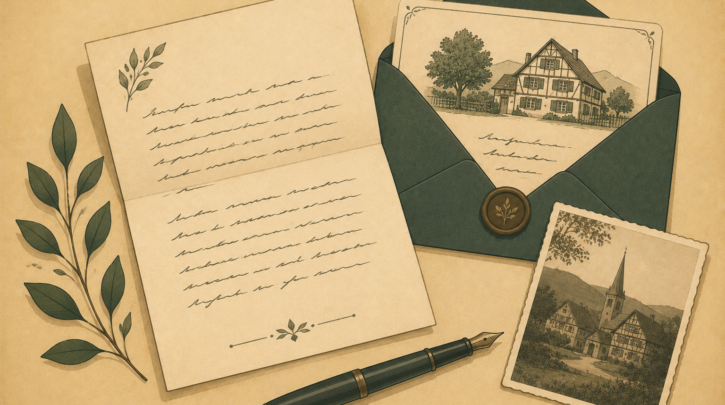
- A carefully written letter: old-fashioned but effective. A short, warm letter in German to people bearing the surname in the ancestral region, explaining the connection and what you hope for, still opens doors that no algorithm can.
Local and community resources
- Heimat and genealogy societies for the ancestral region often know the local families and can point you to living descendants;
- The local parish may still serve the same families your ancestors worshipped beside;
- Village and regional Facebook groups can be surprisingly effective for “does anyone know the X family of Y village?” enquiries;
- Local genealogists and Ortsfamilienbücher can connect historic records to the families still in the area.
A note on official records: Germany’s residents’ registration offices (Einwohnermeldeamt) hold current address data, but privacy rules sharply limit what they release, so do not expect to simply request a relative’s address. The directories and community routes above are both more practical and more respectful.
Approach with sensitivity
When you do make contact, lead with warmth and patience. Explain clearly how you believe you are connected, share what you know, and accept that not everyone will respond and that some will be cautious of a stranger claiming kinship — especially given the privacy culture. A respectful, specific, unhurried approach earns far more replies than an eager one, and the reunions that result are well worth the care.
Put it all together
The winning combination is rarely one method alone. A DNA match that points to a branch, a surname that still clusters in one district, a tree that names the village, and a courteous letter to a household with that surname — together these are how a German-American reconnects with cousins across the ocean. Start from your DNA matches and your ancestral village, and work outward from there.
Surname distribution maps
Before you write to anyone, find out where your surname actually lives in Germany. Surname-mapping tools — Geogen is the best known — plot how common a surname is across German districts, drawing on telephone and population data. A surname that clusters tightly around your ancestral region is a strong confirmation you are searching the right area and tells you which households are most likely to be relatives; a surname scattered evenly across the country is a caution that shared name does not mean shared family. Pairing a distribution map with the ancestral village you have already identified focuses your search powerfully.
Writing the letter that gets a reply
A good letter to a possible German relative is short, warm, and specific. Write in German if you can (a translator is fine), and include: who you are and where you live; the shared ancestor and the village, with dates; how you believe you are connected; one or two concrete details that show you have done real research; and a gentle, open invitation to reply rather than a list of demands. Enclosing a copy of an old family photograph or document often turns curiosity into a response. Keep it to a single page.
Free trial
Ready to put your research into a family tree?
Start a free MyHeritage trial to build your tree online and search historical records and other family trees as you add each generation.
When you get no reply
Silence is common and rarely personal — people are busy, cautious, or simply unsure how to respond to a stranger. Wait several weeks, then try once more, perhaps to a different household with the surname, or shift to a community route: the regional Heimat society, a village Facebook group, or a local genealogist who knows the families. Persistence spread politely across several approaches succeeds far more often than pressing a single unresponsive contact.
Frequently asked questions
Can I just look up a relative’s address in Germany?
Not freely. Germany’s residents’ registration offices hold address data but release little of it for privacy reasons, so the public directories and community routes described above are both more practical and more respectful than seeking official address records.
Is it worth testing my DNA if Germans rarely test?
Yes — upload to MyHeritage and FamilyTreeDNA, which have the strongest European bases, and accept that most matches will be diaspora cousins who can still help. Then combine DNA with directories, surname maps, and letters for the Germany-based connection.
Widen the net with more resources
If directories and a first letter do not land, several further avenues often do. Local and regional newspapers sometimes run family-history or “searching for relatives” notices; the genealogy databases and CompGen’s networks can connect you with researchers working the same villages; and the regional Heimat society for your ancestral area frequently maintains member networks that include people still living there. Each of these reaches Germany-based relatives in ways a DNA database, on its own, usually cannot.
How long does it realistically take to reconnect with German relatives?
It varies from a lucky first letter to a search of months or years, depending on how common the surname is and how well the village is documented. Combining a confirmed DNA branch, a clustered surname, a named village, and a courteous letter is what shortens the odds — persistence across several methods is the reliable path.
Ready to compare tests and current prices? See the side-by-side breakdown on our DNA Testing for German Ancestry hub, where we line up the kits, features, and what each one is best for.
A note on privacy: a DNA test shares your genetic data with a company, so review each provider’s current privacy policy before testing — who can see your data, whether you can delete it, and the rules on law-enforcement access. Policies and company ownership can change. Pricing and database figures in this article are approximate and current as of 2026.