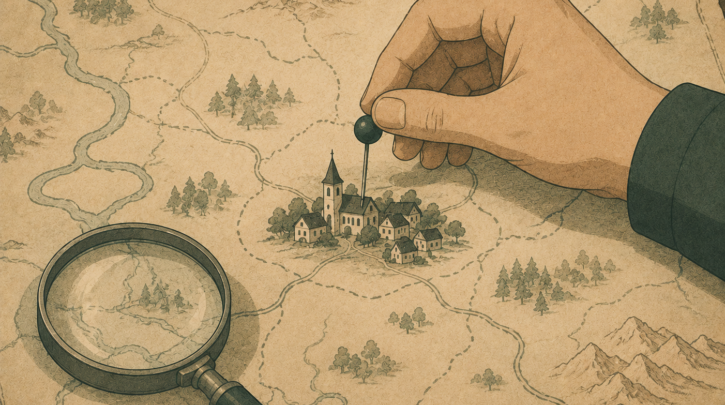

Everything in German genealogy hinges on one piece of information: the name of your ancestor’s village. Without it you cannot open a church book or a registry record, because those records are organised locally, not nationally. And finding the village is rarely as simple as reading a name off a document — German place names repeat by the dozen, and the spelling on an American record is often mangled. This is where the Meyers Gazetteer earns its reputation as the German researcher’s best friend.
Why one village name is not enough
There are, for example, many dozens of places called Neustadt, Hausen, or Kirchberg scattered across the German-speaking lands. A passenger list that says “Hausen” could point to any of them. To search records you need not just a name but the exact place, its administrative district, and — above all — the parish that kept its church books. Pinning that down is the real task.
Meyers Gazetteer: the indispensable index
Meyers Orts- und Verkehrslexikon des Deutschen Reichs — the “Meyers Gazetteer,” free at meyersgaz.org — indexes every inhabited place in the pre-WWI German Empire as it stood around 1912. For each place it lists the administrative jurisdictions and, critically, the ecclesiastical ones: which parish (often shown as the place with a church, or Kirchspiel) served the village, and which civil registry district (Standesamt) recorded its births, marriages, and deaths.
- Search the name and use the map to see exactly where the place sits;
- Read the abbreviations — the site expands them — to find the Catholic and Protestant parishes;
- Use the “nearby parishes” toggle on the map to spot the church your villagers actually attended when the village had none of its own;
- Note the Standesamt for the post-1876 civil records.
Not sure which record to look for first?
Get the German Genealogy Starter Checklist — the ten records to find first, and exactly which database holds each one.
Cross-check the source that named the town
Always weigh the gazetteer against the document that gave you the name. A naturalisation paper, a Hamburg passenger list, a US church record, or an obituary may each spell the place differently or give a nearby market town rather than the tiny home village. Where two independent sources agree on a place, you can proceed with confidence; where they conflict, the gazetteer’s map helps you judge which is plausible.
When the village is now in Poland, Russia, or beyond
If your family came from the former German East — East Prussia, Pomerania, Silesia, Posen — the village may now bear a Polish or Russian name. Meyers still lists the historic German name, and Kartenmeister (kartenmeister.com) converts between the German and modern names for those territories. This is a research field of its own, covered in Researching Germany’s Lost Eastern Territories.
Common questions
I have the village but cannot find any records. Why?
Often the village had no church of its own and belonged to a parish in a neighbouring town — find that parish in Meyers. Coverage online is also partial, so the register may exist only in an archive for now.
The name on my document is not in Meyers. What now?
Try phonetic and Americanised variants, check for a nearby larger town it may have been recorded under, and use the gazetteer’s map browsing to scan the area your other evidence points to.
Reading a Meyers entry field by field
A Meyers Gazetteer entry packs a lot into a few abbreviated lines. Beyond the place name and population, it tells you the higher administrative units (the Kreis and the like), and — most useful for genealogy — the ecclesiastical and civil jurisdictions: which Catholic parish and which Protestant parish served the place, and which Standesamt registered its vital events. The site expands the abbreviations for you, so hover and read carefully; the parish entry is the one that unlocks the church books, and the Standesamt entry the civil records.
Dealing with Americanised spellings
The place name on a US document is often phonetic or anglicised, written down by a clerk who had never seen it spelled. Try saying the name aloud and searching variants; substitute likely letters (a written “W” may be a German “V” sound, “ph” may be “f,” doubled vowels may collapse). Meyers’ search tolerates partial entries, and its map lets you browse the right district when the spelling defeats a direct search.
The map view and nearby parishes
Meyers’ map is more than decoration. Many small villages had no church of their own and belonged to a parish in a neighbouring town, so the records you want are filed under that other place. The map’s toggle for surrounding parishes shows you the candidate churches within range — often the difference between “no records” and a full register.
Other gazetteers and tools
Meyers covers the Empire around 1912, but other tools complement it: Kartenmeister for the eastern territories and their modern Polish or Russian names, GOV (the Historic Gazetteer) on the CompGen network for cross-referencing, and FamilySearch’s place pages. Use them together when a place resists a single source.
Free trial
Looking for your German ancestors beyond the archives?
Start a free MyHeritage trial to build your family tree and search historical records and other family trees for clues about your German ancestors.
Common questions
Two villages share the name. How do I tell which is mine?
Triangulate. Use the region implied by your other evidence — the port of departure, a neighbour’s origin, the religion — and Meyers’ map to choose the plausible one, then confirm by finding your family in that parish’s registers.
From village to records, in order
Finding the village is the means, not the end. Once Meyers gives you the place, note three things and act on each: the Catholic and Protestant parishes (for the church books), the Standesamt district (for civil records from 1876), and the higher districts that tell you which archive holds what is not yet online. Writing these down in one place turns a name into a research plan.
When the gazetteer and your document disagree
Sometimes the place in Meyers does not match the spelling on your family’s record, or the record names a market town while the family actually lived in a hamlet nearby. Trust the cluster of evidence over any single source: if the parish registers for the Meyers place contain your family at the right dates, you have the right village, whatever the American clerk wrote. The proof is always in the parish book.
Is the Meyers Gazetteer really free?
Yes — meyersgaz.org is free to search and use, including its maps and jurisdiction lookups, which makes it the natural starting point before any paid record portal.
What if my ancestor came from a city rather than a village?
Cities had multiple parishes and several registry districts, so you will need to narrow down which one served your family’s neighbourhood or church. Meyers and city address books (Adressbücher) help, and a baptism or marriage record naming the specific church usually settles it.
Just getting started? Grab the free German Genealogy Starter Checklist — a step-by-step worksheet for gathering what you have, finding your ancestral town, and opening the right German records in the right order.