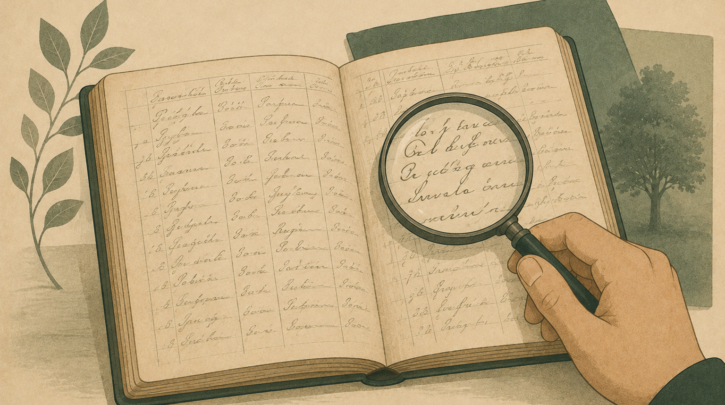

Sooner or later every German researcher meets the same wall: you find the church book, you open the page — and it is covered in a spiky, looping script that looks nothing like the German you may have learned. This is old German handwriting, and learning to read it is the skill that separates researchers who stall at the records from those who actually read them. The good news: it is a craft you can learn, not a language barrier.
Kurrent, Sütterlin, and Fraktur
Three terms cause endless confusion, so let us untangle them:
- Kurrent (Kurrentschrift): the old German cursive used in handwriting from roughly the sixteenth century into the twentieth. This is what most church and civil records are written in.
- Sütterlin: a simplified, more upright form of Kurrent designed by Ludwig Sütterlin and taught in German schools from about 1915 until 1941. It is essentially a school variant of Kurrent, so learning one helps with the other.
- Fraktur: not handwriting at all, but the blackletter printed typeface used in German books and newspapers. You meet it in printed sources rather than registers.
In 1941 the regime abruptly replaced these German scripts with standard Latin handwriting, which is why records from the mid-twentieth century onward are far easier to read.
Not sure which record to look for first?
Get the German Genealogy Starter Checklist — the ten records to find first, and exactly which database holds each one.
Why it looks so hard at first
Several features trip up beginners: certain letters look almost identical (the e and n, or the h and the long-tailed letters), the “long s” resembles an f, double consonants are marked in unfamiliar ways, and spelling was far from standardised. Catholic registers add another layer by using Latin for names, dates, and set phrases.
How to learn it — a practical method
- Start with an alphabet chart for Kurrent and Sütterlin and keep it beside you;
- Build the scribe’s personal alphabet: find words you already know on the page — your ancestor’s name, the village, a known date — and use them to learn how this particular clerk formed each letter;
- Transcribe letter by letter rather than trying to read whole words at speed;
- Learn the recurring vocabulary — the dozen or so terms for born, baptised, married, died, son, daughter, widow — so the structure of an entry guides you even where letters are unclear. Our genealogy glossary collects them.
Tools that help
FamilySearch and several genealogical societies publish free Kurrent and Sütterlin alphabet guides and reading tutorials. Online communities will help decipher a stubborn entry, and emerging handwriting-recognition tools such as Transkribus can assist — though for genealogy you should always verify a machine transcription against the image yourself, since names and dates are exactly where such tools err.
Common questions
Do I need to learn German to read the records?
You need the script and a core record vocabulary more than fluency. Most register entries follow a fixed formula, so once you know the pattern and can read the letters, you can extract names, dates, and places without speaking German.
Why is my record in Latin?
Catholic parishes often kept registers in Latin. The terms are standard and few — our glossary lists them — so Latin entries become routine quickly.
The letter pairs that trip everyone up
A few confusions account for most misreadings. In Kurrent the lowercase e and n are easily swapped, as are u and n (a small mark over the u is the only difference); the long s looks like an f; the h has a long descending loop that can be mistaken for other letters; and capital letters often bear little resemblance to their modern forms. The cure is comparison: find the same letter in a word you already know on the page and use it as your key.
Numbers and dates
Dates are where errors do the most damage, so learn the numerals and the date vocabulary early. Watch for the old forms of the figures, for month names written out (often in Latin in Catholic registers), and for date phrases like eodem die (“on the same day”) that refer back to an earlier entry. A misread digit turns a 1823 into a 1828 and sends you chasing the wrong person.
A transcription method that works
- Transcribe, do not translate, first — write out exactly what you see, letter by letter, before interpreting;
- Build the scribe’s alphabet from known words on the page;
- Use the entry’s fixed structure — you know a baptism names a date, a child, parents, and godparents, so the expected content guides ambiguous letters;
- Leave gaps for what you cannot read and return after more of the hand becomes familiar.
A short Latin survival kit
Catholic registers lean on a small set of Latin terms that recur endlessly: natus/nata (born), baptizatus (baptised), matrimonium (marriage), copulati (married), defunctus/mortuus (died), filius/filia (son/daughter), pater/mater (father/mother). Learn these dozen and most Catholic entries become readable. The glossary has the fuller list.
Common questions
Are AI transcription tools reliable for this?
Tools like Transkribus can help with bulk reading, but they err exactly where it matters most — names, places, and dates — so always verify a machine transcription against the original image yourself.
Capital letters: a special challenge
Lowercase Kurrent becomes familiar fairly quickly, but the capitals are a project of their own — many bear no resemblance to their modern forms, and the same capital can be written quite differently by two clerks. Because surnames and place names begin with capitals, this is exactly where accuracy matters most. Build a reference sheet of the capitals as your clerk writes them, drawn from names you can confirm, and consult it ruthlessly before guessing.
Practice on what you already know
The fastest way to learn is to read records you have already deciphered by other means. Take an ancestor whose dates and names you know from an index, find the original entry, and read it letter by letter — you will absorb the clerk’s hand far faster when you can check yourself against known answers. Then move to the unknown entries on the same pages, where the same hand now reads much more easily.
How long does it take to get comfortable?
Most people read confidently within a few weeks of regular practice, especially if they focus on one parish’s records and one clerk’s hand at a time rather than jumping between many different scribes.
Should I learn Kurrent or Sütterlin first?
Learn Kurrent — it is the broader, older script you will meet across most centuries of records, and Sütterlin is essentially a simplified school version of it. Mastering Kurrent letterforms means Sütterlin entries from the early twentieth century read easily as a bonus.
Just getting started? Grab the free German Genealogy Starter Checklist — a step-by-step worksheet for gathering what you have, finding your ancestral town, and opening the right German records in the right order.