
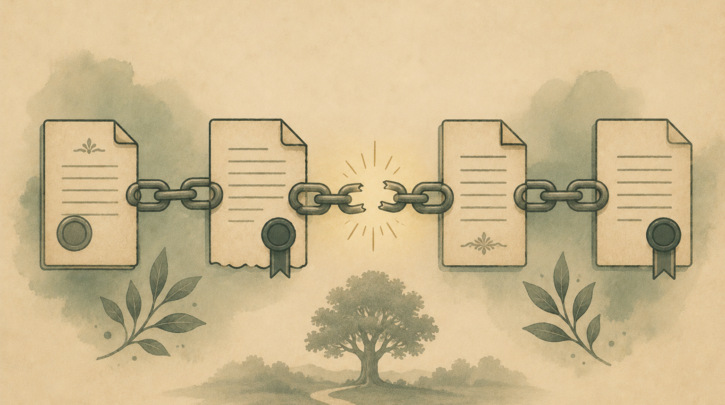

Most German citizenship-by-descent claims that fail do not fail because the family lacks German roots. They fail because, somewhere in the line, an ancestor lost German citizenship before passing it on. Germans call this the broken chain, and understanding it is the single most useful thing you can do before investing time and money in a claim. Get the chain analysis right and everything else follows; get it wrong and you may spend a year assembling documents for a claim that was never going to succeed under §4.
Why the chain matters
Citizenship by descent works link by link. Each ancestor in your direct line had to still be German at the moment the next person in the line was born. If your great-grandfather was German but lost that citizenship in 1922, and your grandmother was born in 1925, then your grandmother was never German — and nothing flowed down to you through that branch. One broken link ends the transmission for §4 purposes, no matter how German the family was before the break.
This is why dates dominate every descent analysis. The decisive comparison is almost always between the date an ancestor lost German citizenship and the birth date of the next person in the line.
Not sure which record to look for first?
Get the German Genealogy Starter Checklist — the ten records to find first, and exactly which database holds each one.
The four classic chain-breakers
1. Naturalising in another country
This is by far the most common. Until the rules changed, a German who voluntarily acquired a foreign citizenship lost their German citizenship automatically — the old §25 rule and its predecessors. A grandfather who became a naturalised US citizen in 1930, before your parent’s birth in 1935, broke the chain at that point. The detail that trips people up: it is the naturalisation date that matters, not the emigration date. Many emigrants lived abroad for decades as permanent residents without ever naturalising — and in those families the chain often held.
2. The pre-1914 emigration rule
Under the nationality law that preceded the 1913 RuStAG, Germans who lived abroad for ten years without registering with a German consulate could lose their citizenship automatically (the so-called Heimatlosigkeit provisions, §21 RuStAG and earlier statutes). Many nineteenth-century emigrants were stripped of citizenship this way long before their American- or Brazilian-born descendants arrived, even if they never naturalised. Pre-1914 lines therefore need especially careful legal analysis.
3. Loss by marriage
German women historically lost their citizenship by marrying foreign men. If your German great-grandmother married a non-German and her children were born afterward, the chain may have broken on the maternal side — though this is exactly the kind of gender-based loss the §5 declaration can now repair for births after 23 May 1949.
4. Legitimacy rules
Children born outside marriage faced their own historic obstacles to inheriting citizenship, particularly through the paternal line before 1 July 1993. As with the maternal-line gap, §5 may offer a remedy for affected descendants.
Does the 2024 law fix a broken chain?
No — not retroactively. The 2024 reform ended the automatic loss of German citizenship for those who acquire a foreign nationality going forward, and it allows dual citizenship. But it does not reach back and undo a loss that already occurred decades ago. A chain that broke in 1930 remains broken under §4. This is the most common misunderstanding we see: people assume the dual-citizenship reform revived their lapsed line. It did not.
The genuinely good news is that the broken-chain problem is only a §4 problem. Where §4 fails, §5 and Article 116/§15 frequently rescue the case — the first for gender and legitimacy gaps, the second for persecution-related losses. A broken §4 chain should send you to those routes, not to the exit.
How to investigate your chain
The decisive evidence is usually a naturalisation record showing when your ancestor became a citizen of another country, compared against the birth dates of the next generation. In the United States, the workhorses are naturalisation petitions and certificates, certificates of arrival, and the “year of naturalisation” and “Pa/Na” columns in the 1900–1930 federal censuses. Comparable records exist in Canada, Australia, Brazil, and Argentina. Where no naturalisation record exists, that absence is itself powerful evidence the chain held.
Our genealogy databases guide and Hamburg passenger lists guide show where to find emigration and arrival records, and the village-finding guide helps you trace the German origin you will ultimately need to evidence.
Free trial
Gathering records for a citizenship application?
Start a free MyHeritage trial to search historical records and family trees for clues to each generation’s documents.
Common questions
My ancestor emigrated but I cannot find a naturalisation record. Is that good or bad?
Often good. If a diligent search of the relevant indexes turns up nothing, it may mean your ancestor never naturalised and the chain stayed intact — though you will need to evidence the search.
The chain broke. Am I finished?
Under §4, through that branch, yes — but check §5 and Article 116/§15 before concluding anything. Many “broken” families qualify another way.
A worked timeline
Lay the dates side by side and the analysis becomes mechanical. Take one branch:
- 1887: ancestor born in Württemberg — German.
- 1907: emigrates to the United States — still German (emigration alone does not end citizenship).
- 1919: naturalises as a US citizen — German citizenship lost at this point.
- 1922: child born — the parent was no longer German, so the child acquires nothing German. The chain broke in 1919.
Shift the 1919 naturalisation to 1925 — after the 1922 birth — and the outcome flips: the child was born to a still-German parent and the chain held. The same family, the same people, a different result, decided by the order of two dates.
The nuances that catch people out
- Derivative naturalisation: in some eras a wife and minor children were naturalised automatically through a husband or father’s naturalisation — so a relative may have lost citizenship without a separate record in their own name.
- Voluntary vs involuntary: the old loss rules generally turned on voluntary acquisition of a foreign citizenship; involuntary acquisition could be treated differently.
- Service and oaths: in some periods, foreign military or government service could also trigger loss.
Where do I find the naturalisation date?
In the United States, look to naturalisation petitions and certificates, certificates of arrival, and the naturalisation columns of the 1900, 1910, 1920, and 1930 censuses; comparable records exist in Canada, Australia, Brazil, and Argentina. See the databases guide for where each is indexed.
If the chain broke, is everything wasted?
No — the records you gathered feed straight into a §5 or Article 116/§15 claim if your family qualifies. The research is rarely wasted, only redirected.
Country notes on naturalisation timing
Because the naturalisation date is so decisive, knowing each country’s historic practice helps you read the records. In the United States, naturalisation typically followed a declaration of intention (“first papers”) and then the petition years later — it is the final certificate date that ended German citizenship, not the first papers. In several countries, women and minor children were naturalised derivatively through a husband or father, so a relative’s loss may be buried in someone else’s file. Reading the dates correctly is often the difference between a viable and a hopeless §4 claim.
Does dual citizenship today help an old broken chain?
No. Today’s acceptance of dual citizenship is not retroactive and cannot revive a chain that broke under the old single-nationality rules. The remedy for a broken chain is a different route — §5 or Article 116/§15 — not the 2024 reform.
Not sure which pathway is yours? Start with the Eligibility Guide
This article is general information, not legal advice. German nationality law is complex and highly fact-specific, and individual cases turn on exact dates and documents. Confirm your situation with the Bundesverwaltungsamt (BVA), your nearest German mission, or a qualified German nationality lawyer before acting. The rules described here are current as of June 2026.