
Of all the moments in a heritage trip, none compares to walking into the village your family came from. It is where the names in your research become a real place — a church, a churchyard, a cluster of old houses, the fields your ancestors worked. But a village visit rewards preparation more than almost any other kind of travel, because the places that matter are small, often locked, and easy to miss. Here is how to make the visit count.
Confirm the village first — exactly
Before anything else, be certain you have the right place. German village names repeat across the country, so confirm yours precisely using the Meyers Gazetteer and your records, and note the parish that served it — the church may be in a neighbouring town. Arriving at the wrong “Neustadt” is a heartbreak entirely within your power to prevent.
Not sure which record to look for first?
Get the German Genealogy Starter Checklist — the ten records to find first, and exactly which database holds each one.
Make contact before you arrive
Small places do not run on tourist hours. Weeks ahead, write to the local parish office (Pfarramt) if you want to see the church or its records, and to the municipal office (Gemeinde or Rathaus) for local history and access. Ask whether a village chronicle (Ortschronik) or local historian exists — many villages have someone who knows every family that ever lived there, and a returning descendant is often a welcome visitor rather than an intrusion. Arranging this in advance is the difference between standing outside a locked church and being shown around it.
What to see when you are there
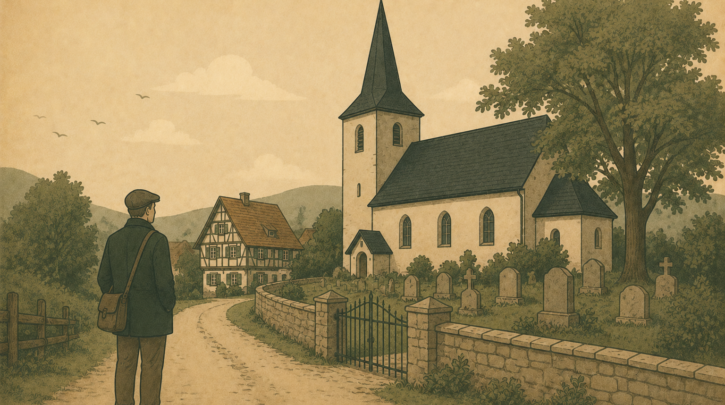
- The church (Kirche): where your ancestors were baptised, married, and buried — often the oldest and most evocative building in the village;
- The cemetery (Friedhof): though note that German graves are frequently reused after a few decades, so very old family headstones may not survive — but the place itself still moves;
- The old family house or farm, if records or local knowledge can identify it;
- The Heimatmuseum or village chronicle, for local history and sometimes photographs of the families who emigrated;
- The Rathaus and the surrounding landscape — the fields, hills, and streets that shaped your ancestors’ daily lives.
What to bring
Carry the things that introduce you and your family: a clear family tree showing your descent from the village, copies of key records, and old photographs of the ancestors who left. These turn a vague “my family came from here” into a specific, credible story, and they are the surest way to spark recognition or help from a local. A small gift from your home country is a gracious touch if you are meeting someone who has helped you.
Etiquette and language
Approach the village and its people with warmth and humility. English is far less common in rural Germany than in the cities, so learn a few phrases, bring a translation app, and consider hiring a local guide or translator for any meeting that matters — it smooths everything and signals respect. Be patient and gracious; you are, in a sense, a guest returning to a home your family left long ago.
Manage your expectations
A small village may be very small indeed — a few houses, no shop, no one expecting you. The records you hoped to see may have moved to a regional archive; the family farm may be gone. None of this diminishes the visit. Standing where your ancestors stood, hearing the church bell they heard, walking the land they left — that is the experience, and it rarely disappoints those who came prepared for the real place rather than an imagined one. Plan the practical side with our heritage trip guide, and let the village be what it is.
Document the visit while you are there
You will want to remember this, and your descendants will treasure it, so record the visit deliberately. Photograph the church inside and out, the churchyard, any surviving family headstones, the old houses, and the surrounding landscape, and note exactly what each image shows. If a local shares documents, photographs, or stories, ask permission to photograph them too — village historians often hold material that exists nowhere else. A simple journal of who you met and what you learned turns a fleeting day into a lasting record, and frequently into new research leads to follow once you are home.
If you meet relatives or locals who knew the family
Sometimes the visit produces the unexpected: a distant cousin still farming the land, or an elderly resident who remembers the family name. Approach such encounters with patience and warmth, lead with your shared connection and a photograph or two, and let the conversation unfold rather than interrogating. Bring a small gift from home as a courtesy, exchange contact details, and follow up afterward with a thank-you and copies of any photos you took together. These relationships, once made, often become the most treasured outcome of the whole journey.
Timing a village visit
Rural Germany runs on its own rhythm. Aim for late spring through early autumn for good weather and long daylight, and check ahead that the parish office and any local contact will be available — August is a common holiday month, and small offices keep limited hours year-round. A Sunday can be ideal for seeing the church in use, but archives and offices will be closed, so plan record-related tasks for weekdays. Confirming a day and time with your local contact in advance is the surest way to avoid arriving to locked doors.
Frequently asked questions
Will anyone in the village know my family?
Sometimes, especially in very small villages with a resident historian or long-settled families — but do not count on it. Make contact ahead through the parish or town office to find out, rather than hoping to be recognised on arrival.
Are the old family graves likely to still be there?
Often not — German cemeteries commonly reuse plots after a few decades, so very old headstones may be gone. The church and the place itself, however, endure, and that is the heart of the visit.
Let the place speak
Beyond the checklist of things to see, leave time simply to be in the village without an agenda. Walk the lanes slowly, sit in the churchyard, look out over the fields toward whatever horizon your ancestors saw every day. Much of what makes an ancestral-village visit profound is not a specific monument but the accumulated sense of place — the scale of the houses, the sound of the church bell, the particular light over the land. Travellers who rush from sight to sight often miss it; those who linger almost never do. This is the moment the whole journey was for.
What if the village is now part of another country?
Many ancestral villages, especially in the former German east, are now in Poland or elsewhere and bear new names. The visit is just as meaningful, but it needs extra preparation — converting the place name and understanding the records first. See researching the lost eastern territories before you travel.
Trip starts with the town. Before you book anything, the free German Genealogy Starter Checklist walks you from a family name to the exact village — the one piece of information a heritage trip cannot do without.