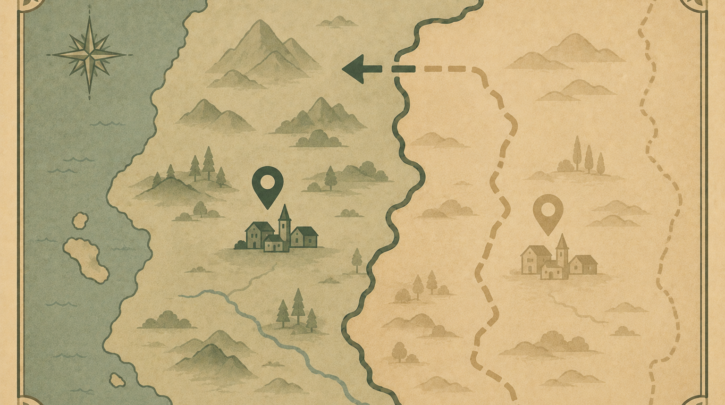

A great many people researching German ancestry eventually discover that their ancestral village is not in Germany at all today — it is in Poland, or Russia, or the Czech Republic. Before 1945, Germany reached far to the east, and millions of Germans lived in regions that changed hands at the end of the Second World War. Researching these lost territories is one of the most challenging — and most rewarding — corners of German genealogy.
What and where the lost territories were
Pre-war Germany included extensive eastern provinces now beyond its borders:
- East Prussia (Ostpreußen) — now divided between Poland and the Russian Kaliningrad region;
- West Prussia, Posen, Pomerania (Pommern), and Silesia (Schlesien) — now largely in Poland;
- Eastern Brandenburg (the Neumark) — now in Poland.
Beyond Germany’s own borders lived large German-speaking communities across central and eastern Europe — the Sudeten Germans of Bohemia and Moravia, the Danube Swabians of the Banat and Hungary, the Transylvanian Saxons, the Volga and Black Sea Germans of Russia, and the Germans of Bessarabia. Many of their descendants emigrated, and many were caught up in the upheavals of the twentieth century.
Not sure which record to look for first?
Get the German Genealogy Starter Checklist — the ten records to find first, and exactly which database holds each one.
Flight, expulsion, and renamed places
At the end of the war the borders shifted west to the Oder-Neisse line, and in the years that followed some twelve to fourteen million ethnic Germans fled or were expelled from these regions. German place names were replaced with Polish, Russian, or Czech ones, and populations were scattered across the new Germany and beyond. For the researcher this creates two distinct problems: finding what the place is called now, and finding where its records ended up.
Converting the place name
Start by establishing the historic German name in the Meyers Gazetteer, which records the Empire as it was around 1912. Then use Kartenmeister (kartenmeister.com), which converts between German and the modern Polish or Russian names for the eastern territories and links places to their parishes and registry districts. Without this conversion step, searching modern archives is nearly impossible.
Where the records ended up
Records from the lost territories are dispersed, and tracking them down is much of the work:
- Polish State Archives hold many civil and church registers for the formerly German regions, with growing online access through their search portals;
- Matricula and Archion carry some church books from these areas, especially where registers were evacuated west;
- The German Federal Archives (Bundesarchiv), including the records of the post-war equalisation-of-burdens process and the expellee card indexes (Heimatortskarteien), document many families who fled;
- Heimat societies (Landsmannschaften) for each lost region preserve local knowledge, village books, and member networks.
To understand why so many of these families had already emigrated before the expulsions, see Why Germans Left.
Common questions
My village name returns nothing in Polish archives. What am I missing?
Almost certainly the modern name. Convert the historic German name with Kartenmeister first, then search the archive under the current Polish or Russian name.
Were all the records destroyed in the war?
Many survived, evacuated or held in regional archives, though losses were real. Coverage varies sharply by region, so persistence and the right archive matter.
A region-by-region orientation
- East Prussia (Ostpreußen): the northern part is now Russia’s Kaliningrad region, the southern part Poland; records are split accordingly, with many in Polish and Russian archives.
- Silesia (Schlesien): now almost entirely in Poland, a populous region whose registers are largely in the Polish State Archives;
- Pomerania (Pommern): the area east of the Oder is now Polish; western Pomerania remains in Germany;
- Posen and West Prussia: now Polish, with strong Polish-archive coverage.
German communities beyond the old borders
Many German researchers descend not from these provinces but from German-speaking colonies scattered across eastern and southeastern Europe: the Germans from Russia (the Volga Germans and the Black Sea Germans), the Danube Swabians of the Banat and Hungary, the Transylvanian Saxons, the Bessarabian Germans, and the Sudeten Germans of Bohemia and Moravia. Each has its own settlement history, its own surviving records, and often its own dedicated society and database — a reminder that “German” ancestry frequently leads far beyond Germany’s borders.
Working the Polish State Archives
For territories now in Poland, the Polish State Archives are the central resource, with a large and growing online presence through their national search portal. Civil and church registers for the formerly German regions are increasingly digitised there. Search under the modern Polish place name — which is why the German-to-Polish conversion via Kartenmeister is the essential first step — and be prepared for finding aids in Polish.
Free trial
Looking for your German ancestors beyond the archives?
Start a free MyHeritage trial to build your family tree and search historical records and other family trees for clues about your German ancestors.
Expellee records in German archives
For families who fled or were expelled, German records document the displacement itself. The Heimatortskarteien — card indexes organised by home locality — were created to reconnect scattered expellees and can place a family in their pre-war village, while the equalisation-of-burdens records held by the Federal Archives document compensation claims that often include detailed family and property information. The regional Heimat societies (Landsmannschaften) hold further local knowledge and member networks.
Common questions
Are these records in German or Polish?
Both, depending on era and archive: pre-1945 registers are usually in German (old script), while modern Polish finding aids and some later records are in Polish. Expect to work across both languages.
A practical search sequence
- 1. Establish the historic German place name in the Meyers Gazetteer;
- 2. Convert it to the modern Polish or Russian name with Kartenmeister, and note the parish and district;
- 3. Search the relevant national archive — the Polish State Archives for most former eastern provinces — under the modern name;
- 4. Check Matricula and Archion for evacuated church registers, and the expellee card indexes for displaced families;
- 5. Contact the regional Heimat society for local expertise and village books.
Why these lines reward persistence
Research into the lost territories is harder than research within modern Germany — records are split across countries, languages, and archives, and wartime losses are real. But it is far from hopeless: Polish digitisation has advanced rapidly, evacuated registers survive in German archives, and the expellee documentation created after the war is unusually rich precisely because reconnecting displaced families was a national project. Families who assume “everything was destroyed” often abandon viable lines.
My ancestor was a Sudeten German or Danube Swabian, not from a German province. Where do I start?
With the community’s own society and databases, and the archives of the relevant country (the Czech Republic, Hungary, Serbia, Romania). These groups are German-speaking but documented largely outside Germany.
Is it worth doing a DNA test for lost-territory ancestry?
It can be, especially when records are hard to reach. DNA can connect you with others researching the same villages and with relatives whose families fled to different countries, sometimes surfacing documents and local knowledge the archives alone would not give you. See the DNA hub to start.
Just getting started? Grab the free German Genealogy Starter Checklist — a step-by-step worksheet for gathering what you have, finding your ancestral town, and opening the right German records in the right order.