
Next to church registers, revision lists are the most important record for tracing Germans from Russia. A single list can show your ancestor’s whole household on one page: grandparents, married sons, daughters-in-law and grandchildren, with everyone’s age. Line up two or three lists from different years and you can follow a family across half a century.
This guide explains what revision lists are, which ones matter for Volga and Black Sea German research, where to find them (often already translated), and how to read one when you can’t.
If you are new to this research, start with our overview of Germans from Russia genealogy.
What a revision list is
A revision list (in Russian, revizskaya skazka, plural revizskie skazki) is a register of the taxable population of the Russian Empire. Peter the Great ordered the first one to fund his wars, and the state used the lists for two purposes: collecting the poll tax and identifying men for military service. Ten “revisions” were carried out between 1719 and 1858.
A revision list is not quite a census. Only taxpayers were counted, which covered most of the population, including the German colonists, but not the nobility or clergy. Because tax was owed per male “soul,” the lists track men carefully: their age at this revision, their age at the previous one, and what happened to anyone who had died, been conscripted or moved away in between.
For genealogists, that design is a gift. Each entry is a household, so a single entry often shows three or four generations at once, and the backward-looking columns let you link one list to the next.
The revisions that matter for Germans from Russia
The first two revisions, 1719 and 1743, were taken before any German colonies existed. The others, together with a few separate colony censuses, are where your ancestors appear.
| Revision | Years | Why it matters |
|---|---|---|
| 3rd | 1761–67 | For the Volga, the 1767 lists record the first settlers of most colonies. This was the first revision to record women. |
| 4th | 1781–82 | Survival for the colonies is patchy. |
| 5th | 1794–95 | Before most Black Sea colonies existed. For the Volga, the separate 1798 colony census is the key list from this period. |
| 6th | 1811 | Interrupted by Napoleon’s invasion, and women were often not listed. For the Volga, translated for 34 colonies. For the Black Sea, a partial list survives. |
| 7th | 1815–17 | The 1816 list is the classic Black Sea source, recording the founding generation of many colonies. For the Volga, the 1816 lists have not been found. |
| 8th | 1833–35 | Found for many colonies in both regions. For Bessarabia, the 1835 list is a key source. |
| 9th | 1850–51 | Found for many colonies. Some Volga lists give women’s maiden names. |
| 10th | 1857–59 | The last revision, taken just before the great emigration to the Americas. Often the last record of a family in Russia before they left. |
After 1858 there were no more revisions. The first and only census of the whole Russian Empire followed in 1897. Its returns were long thought lost, but portions have turned up, including for a few Volga German villages.
What a revision list tells you
From the third revision onward, the lists followed a standard two-page layout. Males of the household are on the left-hand page and females on the right, and each household carries a number. For each person you will usually find:
- Name and relationship to the head of household: wife, son, son’s wife, grandson, brother, and so on.
- Age at this revision.
- Age at the previous revision, for men. For women this column is usually missing.
- What changed since the last revision: a death with its year, conscription into the army, a move to another colony, or an arrival from elsewhere.
- The household number from the previous revision in some lists, which lets you jump straight to the same family in the earlier list.
Some lists add more. The 1798 Volga census gives women’s maiden names, and some lists record where a family moved, which is how researchers trace families into the Volga daughter colonies.
An illustrative example
The household below is invented, but it is laid out the way a translated 1850 Volga or Black Sea list typically reads.
| Household 23: Males | Age in 1834 | Age now | Notes |
|---|---|---|---|
| Johann Schmidt | 41 | 57 | |
| His sons: Peter | 14 | 30 | |
| Jakob | 9 | — | Died 1846 |
| Peter’s son Johann | — | 6 | Born after the last revision |
| Household 23: Females | Age now |
|---|---|
| Johann’s wife Katharina | 54 |
| Peter’s wife Elisabeth | 27 |
| Peter’s daughter Maria | 3 |
From one entry you learn three generations, a death you would otherwise have had to find in a church register, and approximate birth years for everyone. Then you take Johann’s 1834 age and look for him in the 1834 list.
Where to find revision lists
Work through these in order. The first two will often get you what you need without reading a word of Russian.
1. Published translations
- Volga colonies. AHSGR publishes translations of the 1767 First Settlers’ Lists (Igor Pleve’s Einwanderung in das Wolgagebiet), the 1775 lists for twelve colonies, the 1798 census (as single-colony booklets and as a two-volume set by Dr. Brent Mai), the 1811 lists for 34 colonies, and many 1834, 1850 and 1857 lists. The Center for Volga German Studies keeps a list of which censuses exist for each colony.
- Black Sea colonies. Karl Stumpp’s The Emigration from Germany to Russia in the Years 1763 to 1862 reproduces Black Sea revision lists from 1808, 1811 (partial), 1816 and 1858, with an index by colony. Black Sea German Research and Odessa3 host free transcriptions for many colonies, and the Black Sea German-Russian Census volumes cover more, including Bessarabia.
2. FamilySearch images
- Volga. The collection “Revision Lists: Novouzensk (district): Volga Germans, 1850–1862” was filmed at the Samara archive. It covers mainly east-bank (Wiesenseite) colonies, plus lists of west-bank families moving to daughter colonies. The images are entirely in Russian and not indexed. The FamilySearch Wiki page “Revision List Records for Volga Germans” links straight to each village’s images, which saves scrolling through whole films.
- Bessarabia. The 1835, 1850 and 1859 lists are available on FamilySearch.
- Other regions. Search the FamilySearch Catalog by province (for example Kherson, Taurida or Samara) for “revision lists.” FamilySearch has filmed lists from many provincial archives. A free account is needed to view the images.
3. The archives
Lists not filmed or published remain in regional archives in Russia (Saratov, Engels, Samara, Volgograd), Ukraine and Moldova. Most will answer written requests, but expect delays and fees. Ukrainian archives have also been affected by the war. Check with the relevant society’s village coordinator first; someone may already have commissioned the list you need.
How to read an untranslated list
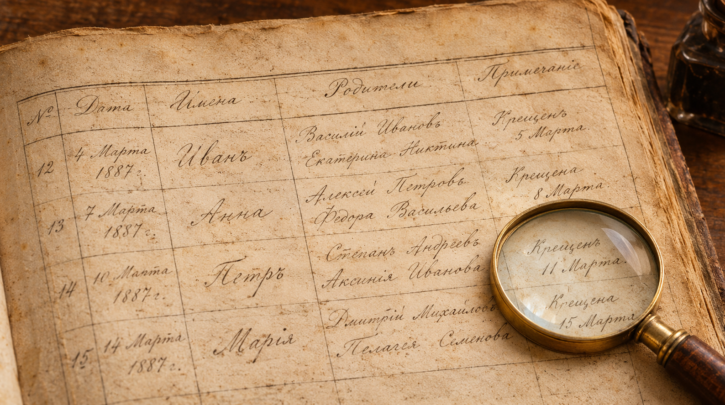
Original lists are handwritten in Russian Cyrillic, sometimes with German names in brackets. You don’t need to learn Russian. You need to recognize a few dozen words and the names in your family.
German names in Russian spelling
Russian clerks wrote German names by sound, and Russian has no letter for the German “H,” so they usually used Г (G). Some clerks also swapped women’s names for their Russian equivalents. A few common examples:
| German | In Cyrillic | Romanized |
|---|---|---|
| Johann | Иоганн | Iogann |
| Heinrich | Генрих | Genrikh |
| Friedrich | Фридрих | Fridrikh |
| Georg | Георг | Georg |
| Katharina | Екатерина | Ekaterina |
| Elisabeth | Елизавета | Elizaveta |
| Hoffmann (surname) | Гофман | Gofman |
| Schmidt (surname) | Шмидт | Shmidt |
Men are often written with a Russian-style patronymic. “Иоганн Петров Шмидт” (Iogann Petrov Shmidt) means Johann, son of Peter, Schmidt, which hands you the father’s name for free.
Words to recognize
- сын (syn): son. дочь (doch’): daughter. жена (zhena): wife.
- умер (umer): died. в рекруты (v rekruty): taken as a recruit.
- выбыл (vybyl): left, moved away. прибыл (pribyl): arrived.
- колонист (kolonist): colonist. колония (koloniya): colony.
FamilySearch offers a free online course, “Germans from Russia: Revision List Records,” that teaches you to locate and read an original revision list for a Volga or Black Sea family. For practice with the handwriting itself, BYU’s free Russian script tutorials include a fully transcribed 1858 revision list. If your colony’s church records are in German, our guide to reading old German handwriting covers the other half of the job.
Mind the calendar
The Russian Empire used the Julian calendar until 1918, twelve days behind the Western calendar in the 1800s. A death “in 1846” is safe, but if you compare an exact date with an American or German record, convert it first.
Common questions
The ages don’t add up between lists. Is it the wrong family?
Not necessarily. Ages in revision lists are often approximate, and a man listed as 41 in one revision may be 55 rather than 57 sixteen years later. Match on the whole household (the wife’s name, the children’s names and their spacing) rather than on one person’s age.
Why is my female ancestor missing?
Some revisions, notably 1811 in many areas, did not list women. Others listed them but didn’t record their ages at the previous revision, so women are harder to trace from list to list. A woman who married into another household after one revision will appear in her husband’s household in the next, usually without her maiden name.
Do I need revision lists if I have the church records?
Yes, ideally both. Church records give exact dates of baptisms, marriages and burials. Revision lists show who lived together, which identifies siblings and in-laws and separates two men of the same name. Where church books are lost, as they are for many Volga colonies in some decades, the revision lists may be all that survives.
Which list should I start with?
Start with the latest list before your family emigrated, usually 1857–58, and work backwards. For Volga families, the 1798 census is the anchor most researchers use. For Black Sea families, it is the 1816 list in Stumpp’s book.