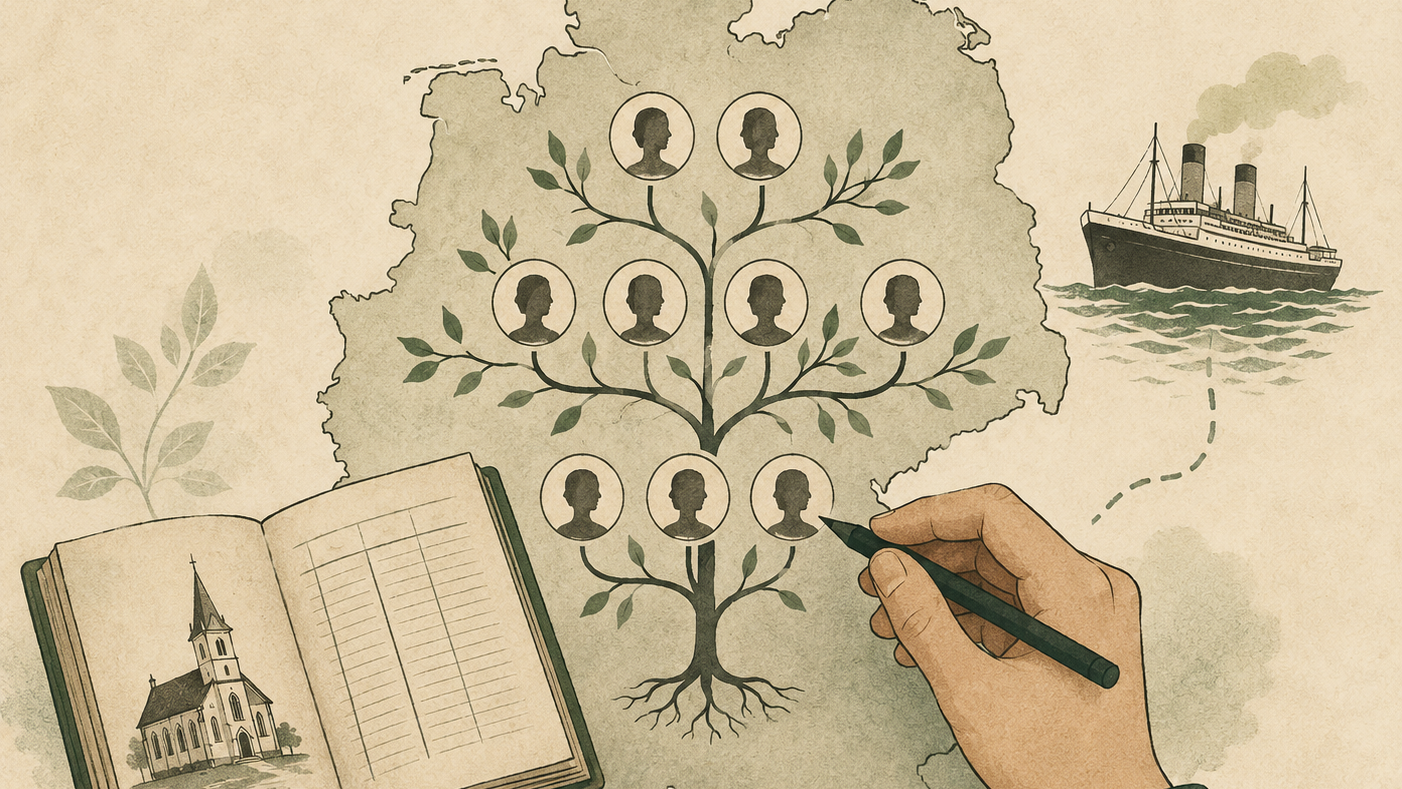
Forty million Americans carry German blood — the largest ancestry group in the United States, and somehow the quietest. Somewhere behind your family’s anglicised surname is a village with a church book, a Hamburg manifest with a hometown column, and a story two world wars taught your family not to tell. German Roots Project exists to help you recover it — the records, the village, and where the law allows, the citizenship.
New here? Follow these six guides in order — each one builds on the last.
If You’re New to German Genealogy
Start at home, work backward, and find the immigrant’s German hometown — the master roadmap every other guide builds on.
2The pivotal step: pinpoint the village with the Meyers Gazetteer before you open a single German record.
3Baptisms, marriages, and burials before 1876 — the primary source for most German family lines.
4Government birth, marriage, and death records from 1876 onward, and how to request them.
5Decode Kurrent and Sütterlin script so the records you work so hard to find are actually readable.
6Five million emigrants recorded with their home villages named — Germany’s great departure archive.
Not sure which record to look for first?
Get the German Genealogy Starter Checklist — the ten records to find first, and exactly which database holds each one.

Citizenship by Descent
German citizenship law is stricter than Ireland’s — and more surprising. Many old emigrant lines lost their citizenship generations ago, but three doors stand open: descent through unbroken chains, restoration for descendants of Nazi-era persecution, and the §5 declaration for maternal lines — with the 2024 law finally allowing dual citizenship for everyone.
The full picture — how descent works, the unbroken chain, the three pathways, and the BVA process. Start here.
Work through descent, the §5 declaration, Article 116 restoration, and naturalisation to see which route fits your family.
Most descent claims fail here: an ancestor who lost citizenship before passing it on. The four classic chain-breakers.
For descendants of those persecuted 1933–1945: no deadline, no generational limit, and free of charge.
Repairs historic gender and legitimacy discrimination in nationality law — but the window closes 19 August 2031.
The complete checklist: vital records, naturalisation proof, apostilles, certified translations, and the right BVA forms.
Realistic timelines — a 1–3 year BVA determination, plus restoration, §5, and passport issuance. There is no fast lane.
The 2024 reform finally allowed dual citizenship for everyone. What changed, and what survived the 2025 repeal.
Germany’s certificate of citizenship: what it is, how it differs from a passport, and why you may want one.
A lawyer isn’t required. When you can do it yourself, when professional help is worth it, and the middle-ground options.
Not sure which pathway is yours? Start with the Eligibility Guide
Genealogy Research Guides
Germany’s two great church-book portals — what each covers, how to navigate them, and which one is likely to hold your parish.
Silesia, Pomerania, East Prussia and beyond: where the records went after 1945, and how to track them down today.
Ports, ships, and passenger lists — tracing the departure side of the journey out of Germany.
Key record terms, abbreviations, and Latin words decoded — a quick reference to keep open as you research.
Looking for the databases themselves? See the full directory: German Genealogy Databases & Free Research Tools.
Free trial
Ready to start researching your German family?
Start a free MyHeritage trial to build your family tree and search historical records and other family trees as you work through these guides.
German Surname Origins
The four ways German surnames formed — patronymic, occupational, locational, and descriptive — and what yours may reveal.
Müller, Schmidt, Schneider and the rest — the most frequent German surnames and what each one originally meant.
Schmidt became Smith, Müller became Miller — how names changed at the border, and how to reverse-engineer the original.
ä/ae, ß/ss, and the many forms of one name — why your surname shows up half a dozen ways across the records.
A step-by-step method for tracing a single surname back through German records to its place of origin.
DNA Testing for German Ancestry
DNA testing can reveal living German relatives and confirm the family connections that anglicised names and lost records obscure — especially valuable where the paper trail crosses a war or a vanished province.
AncestryDNA, MyHeritage, 23andMe, and FamilyTreeDNA compared head-to-head for German genealogy.
The two biggest databases for German matches, compared on reach, tools, and where each one comes out ahead.
Turn a match list into actual living relatives in Germany — what to do once the results land.
Start at the hub: DNA Testing for German Ancestry: Reviews, Comparisons & Guides.
Heritage Travel
From archive visits to village stops — how to build a roots trip that connects you to both the records and the place.
What to expect at the village: the church, the cemetery, the Standesamt, and how to make contact before you arrive.
Hamburg’s emigration museum, where five million departures are remembered — a visitor’s guide for descendants.
Tracing the family who stayed: directories, local records, and DNA — and how to reach out across the language gap.
Stories & Community
Behind every genealogy search is a human story — and German America’s is the great quiet one: the largest ancestry group in the United States, twice taught by history to keep its head down. These guides explore the leaving, the forgetting, and the reclaiming.
Forty million strong yet strangely invisible — how the largest US ancestry group came to keep so quiet.
From the 1683 Krefeld pioneers to the world wars — the great waves of emigration and what drove each one.
After the silence: what it means to recover the language, the village, and the name your family set down.