
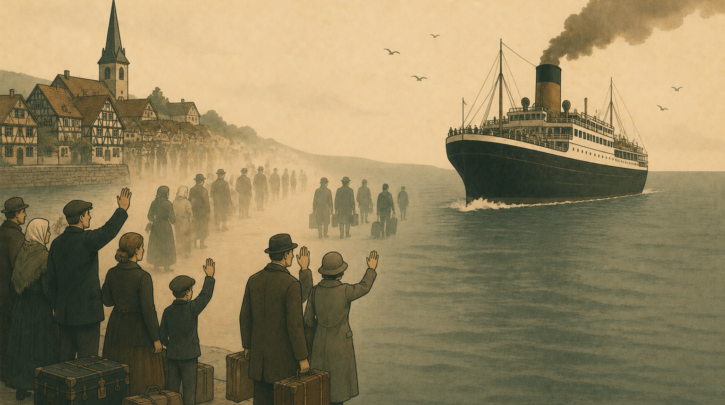

Knowing why and when your ancestors left Germany is not just background color — it is a research tool. The wave they emigrated in points you to the right region, the right religion, and the right records. German emigration was not one event but a series of distinct waves spanning more than two centuries, each with its own causes and its own paper trail.
1683: the first arrivals
German emigration to America begins in 1683, when thirteen Quaker and Mennonite families founded Germantown, near Philadelphia — the first permanent German settlement in what became the United States, led by Francis Daniel Pastorius. Their founding day, 6 October, is still marked as German-American Day. These earliest emigrants came largely seeking religious freedom.
1709: the Palatine exodus
In 1709 war, a brutal winter, and economic hardship in the Palatinate and neighbouring southwest German regions drove a mass exodus. Thousands of “Poor Palatines” fled down the Rhine to the Netherlands and on to England, and from there to New York’s Hudson Valley and to Pennsylvania. The label “Palatine” became a catch-all for German emigrants of the era, and these settlers formed the seed of the Pennsylvania German (“Pennsylvania Dutch,” from Deutsch) community.
Not sure which record to look for first?
Get the German Genealogy Starter Checklist — the ten records to find first, and exactly which database holds each one.
The eighteenth century: Pennsylvania German country
Through the 1700s, Lutherans, Reformed, Mennonites, Amish, and other groups from the Rhineland, the Palatinate, Württemberg, and Switzerland settled heavily in Pennsylvania, often travelling as redemptioners who worked off the cost of passage. Their descendants built the distinctive Pennsylvania German culture still visible today.
The nineteenth century: the great migration
The largest flow came between 1820 and the First World War, when nearly six million Germans emigrated to the United States — the largest immigrant group in America from 1840 to 1890. The drivers were many and often overlapping:
- Land and population pressure: in the southwest especially, repeated division of farmland left families unable to make a living;
- Crop failures and hardship in the 1840s pushed many to leave;
- The 1848 revolutions: their failure sent political refugees — the Forty-Eighters, including figures like Carl Schurz — to America;
- Conscription and the lure of cheap land, particularly after the US Homestead Act of 1862;
- Chain migration: early emigrants drew relatives and whole villages after them.
The regional pattern shifted over time, from the southwest (Baden, Württemberg, the Palatinate, Hesse) early in the century to the northeast — Prussia, Pomerania, Mecklenburg — later on. Separately, the Germans of Russia (Volga and Black Sea) emigrated in large numbers from the 1870s after losing their special privileges, settling across the American plains, Canada, and South America.
Decline after the First World War
Emigration fell sharply after 1918, and US immigration quotas in the 1920s curtailed it further. The great century of German migration was effectively over, though it had already planted the largest German-descended population anywhere outside Germany.
Why this matters for your research
Place the wave and you narrow the search. A Palatine arriving in colonial Pennsylvania, a Forty-Eighter landing in the 1850s, and a Pomeranian farmer leaving in the 1880s each left different records in different places. Knowing the story tells you where to look — and the practical next step is to identify the home village and trace the journey through the passenger lists.
Tracing the emigrant who left? A free MyHeritage trial lets you search passenger lists, census records, and family trees (affiliate link).
Common questions
Does “Pennsylvania Dutch” mean my family was Dutch?
No — “Dutch” here is a corruption of Deutsch, meaning German. Pennsylvania Dutch families were German-speaking, not from the Netherlands.
How does knowing the wave help me find records?
It points you to the right region and religion, which determines which church or civil records — and which portal — to search. See How to Trace Your German Ancestry.
The Germans from Russia
A distinct and often overlooked stream descends from Germans who had earlier settled in the Russian Empire. Invited by Catherine the Great from the 1760s to farm the Volga, and later by Alexander I to settle the Black Sea region, these communities kept their German language and faith for generations. When their privileges — including exemption from military service — were withdrawn in the 1870s, hundreds of thousands emigrated again, this time to the Great Plains of the United States and Canada and to South America, bringing hard winter wheat that transformed prairie agriculture. If your family tradition mixes “German” and “Russian,” this is very likely the story.
Religious migrations
Faith drove many of the distinct movements. Mennonites and Amish left the Palatinate and Switzerland for Pennsylvania in the eighteenth century to escape persecution and military service, and Mennonites from Russia made a second mass migration to Kansas and Manitoba in the 1870s. Pietists, Separatists, and other groups founded communal settlements in America. Religion shaped not only why these families left but which records document them.
Leaving the eastern provinces
Emigrants also came in numbers from the eastern provinces — Pomerania, West and East Prussia, Posen, Silesia — particularly in the later nineteenth century, settling heavily in the upper Midwest. For these families, research eventually leads into the lost eastern territories and their renamed places.
How emigration changed across the century
The character of the migration shifted over time. Early nineteenth-century emigrants were often families leaving the crowded southwest for farmland; mid-century brought the political refugees of 1848 and, after them, a broad economic exodus; later decades drew more single young people and more emigrants from the northeast, often moving along chains established by earlier relatives. Dating your ancestor within this arc tells you a great deal about who they were and why they left.
Common questions
My family said they were “German-Russian.” What does that mean?
Usually that they were ethnic Germans who had lived in the Russian Empire (the Volga or Black Sea colonies) before emigrating again in the 1870s or later. Their records and societies are distinct from those of Germany proper.
Push and pull together
No single cause explains German emigration; it was always a balance of forces pushing people out and pulling them across the ocean. Pushing: land too divided to support families, crop failures, crushing rural poverty, conscription, and political disappointment after 1848. Pulling: cheap and abundant American land, religious freedom, the encouraging letters of relatives who had already gone, and the steamship lines that made the crossing faster and cheaper as the century wore on. Most emigrants left for a combination of these, not one.
What the timing tells you
Because the causes shifted over time, the date your ancestor left is itself a clue to who they were. A pre-1850 departure points to the crowded southwest and often to religious or land pressures; an arrival in the early 1850s raises the possibility of a political refugee; a departure in the 1870s–1880s suggests the later economic wave, possibly from the northeast or from the German colonies in Russia. Pair the date with the region of origin and a coherent story usually emerges.
Did most German emigrants intend to return?
Most did not — the great majority who left in the nineteenth century settled permanently, which is why the German-descended population abroad grew so large. Some did return, but the dominant pattern was a one-way journey and chain migration that drew more relatives after them.
Just getting started? Grab the free German Genealogy Starter Checklist — a step-by-step worksheet for gathering what you have, finding your ancestral town, and opening the right German records in the right order.