
If your German-speaking ancestors homesteaded in the Dakotas or Saskatchewan and their papers say they were born near Odessa, in “Cherson,” or in Bessarabia, you are researching Black Sea Germans. They are a different community from the Volga Germans: they arrived later, came from different parts of Europe, and left a different set of records.
The good news is that their records are some of the best indexed of any German group in the former Russian Empire, largely thanks to volunteer translators. This guide shows you how to identify the colony, find the church and census records, and use the wartime resettlement files that often contain a ready-made family tree.
New to this topic? Start with our overview of Germans from Russia genealogy.
Who the Black Sea Germans were
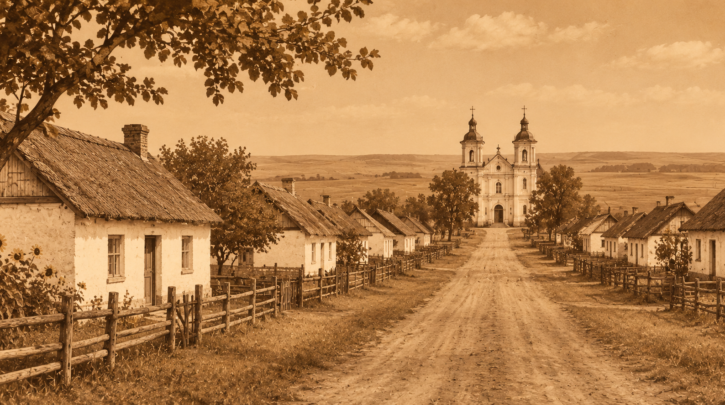
On 20 February 1804, Tsar Alexander I issued a manifesto inviting European farmers to settle “New Russia,” the steppe north of the Black Sea that Russia had recently taken from the Ottoman Empire. Colonists were promised land, religious freedom and ten years without taxes. Over the following decades they founded hundreds of villages in what are now southern Ukraine and Moldova.
Unlike the Volga colonists, who came mostly from Hesse, Black Sea colonists came largely from the southwest: Alsace, Baden, the Palatinate and Württemberg. Many also came from German communities that had already settled in Hungary and in Prussian Poland.
The Odessa-area colony groups
Around Odessa, colonists were grouped into districts of neighboring villages, usually sharing one religion and one parish. These districts are the units you will see in records and research groups.
| Colony district | Religion | Where the founding families came from |
|---|---|---|
| Kutschurgan (founded 1808): Selz, Kandel, Baden, Strassburg, Mannheim, Elsass | All Catholic | Mostly Alsace, then Baden, the Palatinate and Prussia |
| Beresan: Landau, Speyer, Sulz, Karlsruhe, Katharinental, Rastadt, München and others | 7 Catholic, 4 Lutheran | Mostly the Palatinate, Baden and Alsace |
| Glückstal: Glückstal, Neudorf, Bergdorf, Kassel | All Lutheran | Mostly Württemberg and Alsace, some from Hungary |
| Grossliebental: Grossliebental, Kleinliebental, Josefstal, Mariental, Franzfeld and others | 9 Lutheran, 4 Catholic | Württemberg, Hungary, Alsace |
There were also smaller groups, such as the Swedish colonies near Kherson, and many later “daughter colonies” founded as the original villages filled up. In the Kutschurgan district, for instance, daughter villages carried names like Neu-Kandel and Neu-Selz.
Other Black Sea settlement areas
- Bessarabia. The land between the Prut and Dniester rivers, today split between Moldova and Ukraine. Germans settled there from 1813, many arriving from Prussian Poland. It was Russian for most of the 1800s and Romanian between the world wars.
- Taurida and Crimea. Lutheran and Catholic colonies along the Molotschna River, alongside the Mennonite Molotschna settlement, plus colonies on the Crimean peninsula.
- Mariupol and Ekaterinoslav. Further east, near the Sea of Azov.
Step 1: Identify the colony from American records
Black Sea Germans began emigrating as soon as Russia ended their privileges in 1871 and introduced conscription in 1874. The first group reached Yankton, in Dakota Territory, in the spring of 1873. Bessarabian Germans followed from the 1870s onward. The Dakotas, Saskatchewan and Manitoba drew the largest numbers, with smaller groups in Nebraska, Montana, Washington and South America.
Look for the colony name in obituaries, parish anniversary books, naturalization papers and Hamburg passenger lists (see our guide to Hamburg passenger lists). Records may name the colony, the district, or only the province. In the Russian Empire, the Odessa-area colonies sat in Kherson province (often spelled “Cherson”), so “Cherson, Russia” on an American document points you toward the Odessa region.
Knowing the religion narrows the search quickly. A Catholic family from the Odessa area is very likely from the Kutschurgan or Beresan districts. A Lutheran family is more likely from Glückstal, Liebental or Bessarabia.
Watch out for renamed villages
Almost every colony has several names. Each had its German name and often an official Russian one, and most were renamed again in Soviet times. Ukraine changed many more names in September 2024 to replace Soviet-era ones, and some villages have merged. Kandel, for example, was renamed Rybalske in Soviet times and is now part of the town of Lymanske, together with neighboring Selz. Strassburg is now Kuchurhan.
Our German–Russian colony name finder lists the main names. The Germans from Russia Settlement Locations map also tracks the 2024 Ukrainian changes.
Step 2: Find the church records
In the Russian Empire, the parish register was the official record of births, marriages and deaths. Which records survive depends on your family’s religion.
Lutheran and Reformed families
Each Lutheran parish sent a yearly duplicate of its register to the Lutheran Consistory in St. Petersburg. For the Odessa-area colonies, no original parish books are known to survive, but the St. Petersburg duplicates do. FamilySearch has imaged them as “Russia, Lutheran Church Book Duplicates, 1833–1885,” and Black Sea German Research and Odessa3 have published name indexes and translations, so you can usually search by surname before you open a single image. For Bessarabia, some original parish books were taken to Germany during the 1940 resettlement.
Catholic families
Catholic parishes kept one copy locally and sent another to the bishop: the Archdiocese of Mohilev before the 1850s, and then the Diocese of Tiraspol. The diocesan copies are now at the State Archive of Saratov Oblast in Russia, mainly in the Tiraspol Roman Catholic Consistory collection (1853–1918). Entries are in Latin until the 1840s and in Russian Cyrillic after that.
The Saratov archive accepts requests for digital or certified paper copies of these registers. Before ordering, check Black Sea German Research. Volunteers have already extracted thousands of Kutschurgan, Beresan and Liebental Catholic entries, and the record you need may be translated already.
For Kutschurgan Catholics there is also the Kutschurgan Spousal Project, a printed index built from the 1852 Catholic church census of Baden, Elsass, Kandel, Mannheim, Selz and Strassburg. It is a quick way to place a couple in the right village.
For help reading the registers themselves, see our guides to German church records and reading old German handwriting.
Step 3: Use the census lists
Russian revision lists recorded every household in a colony, with ages. For Black Sea research, the most useful are:
- The 1816 census, which survives for many mother colonies and records the founding generation. Karl Stumpp reproduced it, often with places of origin, in The Emigration from Germany to Russia in the Years 1763 to 1862.
- Bessarabian revision lists of 1835, 1850 and 1859, available on FamilySearch and transcribed in the Black Sea German-Russian Census volumes.
- Colony-specific lists, such as early Kutschurgan censuses from the 1810s and the 1858 census of the Glückstal colonies, published by the research societies.
Our guide to Russian revision lists explains how to read and use them.
Step 4: Don’t skip the EWZ files
For families who were still in the Black Sea region or Bessarabia during the Second World War, the most valuable genealogical source is often a Nazi-era immigration file.
In 1940, after the Soviet Union annexed Bessarabia, almost the entire German population was resettled to German-occupied Poland. In 1943–44, as the German army retreated, around 340,000 to 350,000 Black Sea Germans were evacuated west to the Warthegau, in occupied western Poland. In both cases the German immigration office, the Einwandererzentralstelle (EWZ), interviewed each family and recorded its ancestry, often back to the 1850s or 1860s.
- EWZ-50 covers the Black Sea Germans of 1943–44.
- EWZ-51 covers the Bessarabian Germans of 1940 and is the single most important source for Bessarabian research.
- Koblenz questionnaires at the German Federal Archives were completed before the EWZ files and add further family detail.
The US National Archives holds the EWZ files on microfilm, and Black Sea German Research includes many EWZ indexes in its database. Even if your direct ancestors left in the 1880s, a cousin who stayed may appear in an EWZ file listing the same grandparents.
A note on what came after: many of the families evacuated in 1943–44 were caught by the advancing Red Army or handed back to the Soviet Union after the war, and sent to labor camps in Siberia and Kazakhstan. If a branch of your family disappears from the records after 1944, this is the most likely reason.
Step 5: Trace the family back to Europe
Stumpp’s book is the standard starting point, because it gives places of origin for thousands of Black Sea colonist families. From there:
- For families from Baden, Württemberg or the Palatinate, search the parish registers through our Archion and Matricula guide and how to find your ancestor’s village in Germany.
- For families from Alsace, the Bas-Rhin and Haut-Rhin departmental archives put their parish registers online for free. Our sister site French Roots covers French research.
- For families who came via Hungary, see Hungarian Roots. Their Hungarian stop is often recorded in the colonists’ lists.
Key Black Sea German resources
| Resource | Use it for |
|---|---|
| Black Sea German Research | Free. Translated Lutheran and Catholic church records, the Black Sea German database (including EWZ indexes), colony maps and village plat maps. |
| Germans from Russia Heritage Society (GRHS) | Bismarck, North Dakota. The main society for Black Sea and Bessarabian families, with village pages, a library and member databases. |
| Odessa3 | Free digital library. St. Petersburg Consistory indexes, census transcriptions, ship lists and a German–Russian village list showing the parish for each village. |
| Germans from Russia Heritage Collection, NDSU | Village histories, photographs (including churches in Kandel and Selz) and family collections. |
| Germans from Russia Settlement Locations | Maps of every colony, with historic and current place names. |
| Glückstal Colonies Research Association | Published censuses and parish extracts for the Glückstal colonies. |
Common questions
My ancestor was from Kandel (or Selz, Baden, Strassburg). Where do I start?
All six Kutschurgan colonies were Catholic, so your main sources are the Diocese of Tiraspol registers at the Saratov archive and the translations on Black Sea German Research. Use the 1852 Catholic census (via the Kutschurgan Spousal Project) to place the family. If anyone in the family was still in the colony in 1943–44, look for an EWZ-50 file. GRHS and NDSU also hold Kutschurgan village histories and photographs.
Are Black Sea Germans the same as Volga Germans?
No. Volga Germans came in the 1760s, mostly from Hesse, and settled near Saratov. Black Sea Germans came from 1804 onward, mostly from southwest Germany and Alsace, and settled near Odessa and in Bessarabia and Crimea. Their records are held in different places. See our Volga German genealogy guide if your family was from the Volga.
Can I still get records from Ukraine?
Some regional archives in Ukraine hold colony and parish material, and access has been disrupted by the war. Much of what researchers need, however, is held outside Ukraine (the St. Petersburg duplicates, the Saratov Catholic registers, the EWZ files) or has already been translated by volunteers. Start with those.
Can DNA testing help?
Yes. Black Sea German families married within their colony districts for generations, so DNA tests turn up many cousins descended from the same villages. Matching a cousin with a documented tree can confirm a colony or a set of grandparents when the paper trail stops. See our DNA testing hub.
Where to go next
Pin down the religion and the colony first. Then search the translated church records and the EWZ indexes before ordering anything from an archive. Chances are good that a volunteer has already transcribed the register you need, and that a distant cousin has already posted the family to one of the societies above.
Thank you for this insightful article!