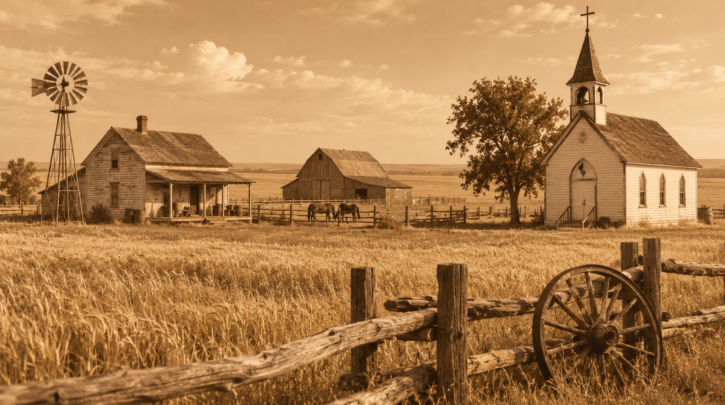

Your great-grandparents spoke German, cooked German food and went to a German-speaking church in Kansas or North Dakota. Yet every census, passenger list and naturalization paper says they were born in Russia. If that sounds familiar, you are almost certainly descended from the Germans from Russia (in German, Russlanddeutsche): German-speaking farmers who lived in the Russian Empire for a century or more before crossing to the Americas.
Their story runs through three countries, and so does the research. American records lead you to a colony in Russia or Ukraine. Russian-era records lead you to a village in Germany. This guide explains who these settlers were, how to tell which group your family belonged to, and which records and organizations to use at each stage.
Who were the Germans from Russia?
In 1762 and again on 22 July 1763, Empress Catherine the Great issued manifestos inviting foreigners to settle the empire’s empty frontier lands. The 1763 offer was generous: free land, travel money, freedom of religion, local self-government, years without taxes, and exemption from military service. Thousands of families from Hesse, the Rhineland, the Palatinate and southwest Germany, worn down by the Seven Years’ War, accepted.
Settlement came in waves, and each wave produced a distinct community with its own records:
- Volga Germans (1760s). Roughly 25,000 to 27,000 colonists founded 104 “mother colonies” on both banks of the Volga River near Saratov, then many “daughter colonies” as the population grew.
- Black Sea Germans (from 1804). Tsar Alexander I’s manifesto of 20 February 1804 opened the steppes of “New Russia,” the coast north of the Black Sea in today’s southern Ukraine. Colony groups formed around Odessa (Liebental, Kutschurgan, Glückstal, Beresan) and further east in Taurida and Crimea.
- Bessarabian Germans (from 1813). Colonists settled the newly annexed province of Bessarabia, today mostly Moldova plus a strip of Ukraine.
- Mennonites. Anabaptist settlers from the Danzig area founded the Chortitza (1789) and Molotschna (1804) colonies.
- Volhynian Germans (mainly later 1800s). They farmed in northwestern Ukraine, many arriving from Russian Poland.
Each group kept to itself, married within its own faith and colony cluster, and later emigrated in its own pattern. That is why identifying the group is your first real research task.
Why they left Russia
The privileges did not last. On 4 June 1871 (16 June on the Western calendar), Tsar Alexander II revoked the colonists’ special status and placed their villages under ordinary Russian administration. In January 1874 a new universal military service law ended the exemption from conscription that the colonists had been promised “forever.”
Emigration began almost immediately. Black Sea Germans reached Yankton, in Dakota Territory, in the spring of 1873. Volga German delegates toured Kansas and Nebraska in 1874, and the first Volga families left for Topeka in 1875. Over the next forty years, Germans from Russia settled across the Great Plains and the West, and also in Canada, Argentina and Brazil. The flow continued until the First World War closed the door.
As a rough rule, settlement areas in North America tell you something about origins:
| Where your family settled | Most likely origin |
|---|---|
| Ellis and Rush counties, Kansas; Lincoln, Nebraska; eastern Colorado; Portland, Oregon; eastern Washington | Volga colonies |
| Central and southern North Dakota; southeastern South Dakota; Saskatchewan | Black Sea colonies (Odessa area) or Bessarabia |
| Central Kansas; southeastern Nebraska; Manitoba | Mennonite colonies |
| Western Canada, especially Alberta and Manitoba | Volhynia is a common origin, among others |
Treat this table as a starting hypothesis, not proof. Plenty of families moved after arrival, and every state had a mix.
Step 1: Work out which group your family came from
Start in America, with the records you can reach most easily, and look for four clues.
- Religion. Lutheran, Reformed, Catholic or Mennonite. This decides which church records exist and where they went, so pin it down early. Funeral cards, obituaries and the church where your immigrant ancestor married usually answer it.
- Colony name. Obituaries, church anniversary books, naturalization papers and family Bibles often name the home village: Norka, Kandel, Glückstal, Hoffnungstal. Write the name down exactly as spelled.
- Census clues. The 1910 and 1920 US censuses asked for “mother tongue.” “Born: Russia, Mother tongue: German” is the classic signature of this group.
- Arrival date and port. The 1900–1930 censuses give a year of immigration. Many Germans from Russia sailed from Hamburg or Bremen to New York or Baltimore. Hamburg’s departure lists survive; most of Bremen’s do not. See our guide to Hamburg passenger lists.
Once you have a colony name, you can place it in one of the groups above. That tells you which records and which research society to use next.
Step 2: Find the colony and its other names
This is where many researchers stall. Most colonies carried two names: a German one used by the settlers and an official Russian one. After 1917, and again after the 1940s, many were renamed, and the Ukrainian spelling today may differ again. Kandel, a Catholic colony in the Kutschurgan group near Odessa, was renamed Rybalske in Soviet times and is now part of the town of Lymanske, in Ukraine’s Odesa region.
Always record every known name for the colony. Archive catalogs, FamilySearch and Russian or Ukrainian sources will each use a different one. Our German–Russian colony name finder lists the German, Russian and modern names for the major colonies.
Step 3: Use the Russian-era records
Germans from Russia are, by Eastern European standards, well documented. Two record types do most of the work.
Church records
In the Russian Empire, the church register was the civil record. Births, marriages and deaths were kept by the parish, usually in German (Lutheran) or Latin (Catholic), and a duplicate was sent each year to church headquarters.
- Lutheran and Reformed parishes sent duplicates to the St. Petersburg Lutheran Consistory. FamilySearch has imaged them as the collection “Russia, Lutheran Church Book Duplicates, 1833–1885,” and volunteer indexes on Black Sea German Research and Odessa3 make them searchable by name.
- Catholic parishes fell under the Diocese of Tiraspol, seated in Saratov, from 1848. Surviving duplicates sit in archives in Saratov and in Ukraine. Black Sea German Research has translated many Catholic parish entries for the Odessa-area colonies.
- Mennonite congregations kept their own church books, and many were lost. Mennonite researchers lean heavily on the censuses below and on the GRANDMA database of the California Mennonite Historical Society.
For more on reading and using parish books, see our guide to German church records (Kirchenbücher). The handwriting skills carry over directly; see how to read old German handwriting.
Revision lists and colony censuses
The Russian state counted its taxpayers in “revisions,” census-like lists of every household. Empire-wide revisions were taken in 1795, 1811, 1816, 1834, 1850 and 1857–58. The Volga colonies also have a separate colony census from 1798. Because the lists name every household member with ages, you can follow a family across sixty years and often across three generations. Our guide to Russian revision lists explains how to find and read them.
Arrival lists and wartime files
- Kulberg lists (1766). Ivan Kulberg’s lists record Volga colonists as they arrived at Oranienbaum, near St. Petersburg, with family members and often a place of origin in Germany. They have been published in English.
- EWZ files (1939–1945). When Nazi Germany resettled ethnic Germans from Bessarabia, Volhynia and the Black Sea region, the immigration office (Einwandererzentralstelle) created detailed family files, often with pedigrees reaching back to the 1800s. The US National Archives holds them on microfilm. They rarely cover Volga Germans, who had been deported east in 1941.
Step 4: Find the village in Germany
The last leap is from the colony back to a village in Germany. Karl Stumpp’s book The Emigration from Germany to Russia in the Years 1763 to 1862 is the classic starting point. The AHSGR German Origins Project collects confirmed places of origin for Volga and Black Sea families, and the Kulberg lists often name the home town directly. Once you have a candidate village, our guides to finding your ancestor’s village in Germany and Archion and Matricula take it from there.
The organizations that hold the key collections
Unusually for German research, much of the best material for Germans from Russia was gathered by volunteer societies in North America. They are worth knowing early.
| Organization | Best for |
|---|---|
| Black Sea German Research | Free. Translated church records, colony maps and the Black Sea German database for Odessa-area, Bessarabian and Crimean colonies. |
| Center for Volga German Studies | Volga colony histories, origins research and a step-by-step Volga research guide. |
| American Historical Society of Germans from Russia (AHSGR) | Lincoln, Nebraska. Village coordinators, translated revision lists, the German Origins Project and an obituary collection. |
| Germans from Russia Heritage Society (GRHS) | Bismarck, North Dakota. Strong on Black Sea and Bessarabian families, with a library and member databases. |
| Germans from Russia Heritage Collection, NDSU | Fargo, North Dakota. Village histories, photographs and family collections. |
| Odessa3 | Free digital library. St. Petersburg Consistory indexes, census transcriptions, ship lists and EWZ indexes. |
| Society for German Genealogy in Eastern Europe (SGGEE) | Volhynian Germans and Germans from Russian Poland. |
For general German databases that also cover this group, see our German genealogy databases and free tools.
Guides in this series
- Volga German genealogy: the 104 mother colonies, the Kulberg lists and the 1798 census
- Black Sea and Bessarabian German genealogy: Odessa-area colonies, Bessarabia, Crimea and the EWZ files
- Russian revision lists explained
- German–Russian colony name finder
- Can Germans from Russia descendants get German citizenship?
Common questions
My ancestor’s papers say “Russian.” Was he Russian or German?
Both, in different senses. He was a subject of the Russian Empire, so American officials recorded his nationality as Russian. Culturally and linguistically he was German, and his family had usually come from Germany three or four generations earlier. In US records you will see both “Russia” and “German-Russian.”
Were the records destroyed?
Far fewer than people expect. Because duplicates of church registers went to St. Petersburg or to the diocese, two copies often existed, and one of them frequently survived. Coverage varies by colony and by faith; Lutheran records from 1833 to 1885 are the best preserved. Records from the Soviet period are harder to reach.
What happened to the families who stayed?
On 28 August 1941, after Germany invaded the Soviet Union, a Soviet decree abolished the Volga German Autonomous Republic and ordered all Volga Germans deported to Siberia and Kazakhstan. Black Sea Germans, under German occupation, were moved west in 1943–44, and many were later sent back to the USSR. Since the late 1980s, hundreds of thousands of their descendants have resettled in Germany. Some of your relatives’ cousins may be living there today.
Can a DNA test show German-from-Russia ancestry?
MyHeritage DNA identifies the Volga German community as a distinct genetic group, so a match to that group is a strong hint of Volga descent. Because these communities married within their colonies for generations, you will often match many distant cousins from the same villages, which helps confirm a colony when the paper trail is thin. See our DNA testing hub.
Can I get German citizenship through Germans-from-Russia ancestry?
Usually not through descent. Ancestors who left Russia before the First World War were Russian subjects, not German citizens, so there was no German citizenship to pass down. The main exception is families naturalized by Germany during the Second World War, mostly Black Sea, Bessarabian and Volhynian Germans resettled in 1940–44, who emigrated after the war. Germany’s separate program for ethnic German resettlers (Spätaussiedler) applies to people living in the former Soviet states, not to descendants in the Americas. If another branch of your family came directly from Germany, check the eligibility guide. Our Germans from Russia citizenship guide covers the details.
Where to go next
Start with what you can confirm at home: religion, a colony name and an arrival year. With those three facts, the records listed above become far easier to search, and the Germans from Russia communities are among the most generous research groups you will find. Post your colony and surnames to the relevant society or village coordinator. Someone has often already traced the family you are looking for.