
For German ancestry research, two autosomal tests rise above the rest: MyHeritage and AncestryDNA. Both estimate your ethnic origins and match you with genetic cousins, but they have very different strengths, and the right choice depends on whether your research leans toward the American or the European side of the Atlantic. Here is how they compare where it matters for German roots.
Disclosure: this article contains affiliate links to MyHeritage. If you buy a DNA kit or start a trial through them, we may earn a commission at no extra cost to you. We do not earn commissions from AncestryDNA or the other companies mentioned. See our affiliate disclosure.
Database size and where the testers are
MyHeritage is far stronger in Europe, and German and other European users frequently report more relevant matches from their ancestral countries on MyHeritage than on Ancestry — though its database is smaller, at around 9.6 million samples. AncestryDNA has the larger database by a wide margin, with well over twenty million testers, and its dominance in the United States means most of your American German-descended cousins are there. If you hope to match people in or recently from Germany, MyHeritage often does better; if your living cousins are mostly in the US, Ancestry wins on numbers.
MyHeritage also offers two optional extras. DNA Traits is a set of recreational reports on everyday characteristics, unlocked for a one-time fee per kit. DNA 360° is a separate kit that adds health and wellness reports to your ancestry results; it is for informational purposes only, is not a diagnostic test, and is currently sold only to adults in the United States and United Kingdom. Check MyHeritage for what is included (affiliate link).
DNA test
Ready to try a MyHeritage DNA test?
See what a MyHeritage DNA test includes, from ethnicity estimates to DNA matches with relatives who have tested too.
Ethnicity estimates
Both break out a “Germanic Europe” component and divide the world into hundreds of regions, and both refine their estimates over time. MyHeritage is known for detailed European breakdowns; AncestryDNA updates frequently and offers a “by parent” split that separates your estimate into maternal and paternal sides. As always, treat the percentages as approximations — neither can pinpoint a German region precisely, because German DNA overlaps with that of its neighbours.
Features that matter for genealogy
- MyHeritage: AutoClusters groups your matches into likely shared-ancestor clusters, and a chromosome browser lets you compare exact shared segments — a tool serious genetic genealogists value and one Ancestry does not offer.
- AncestryDNA: ThruLines suggests how you connect to matches through shared ancestors, and the platform ties into an enormous collection of (mostly US) historical records — though viewing match trees needs a subscription.
The upload advantage
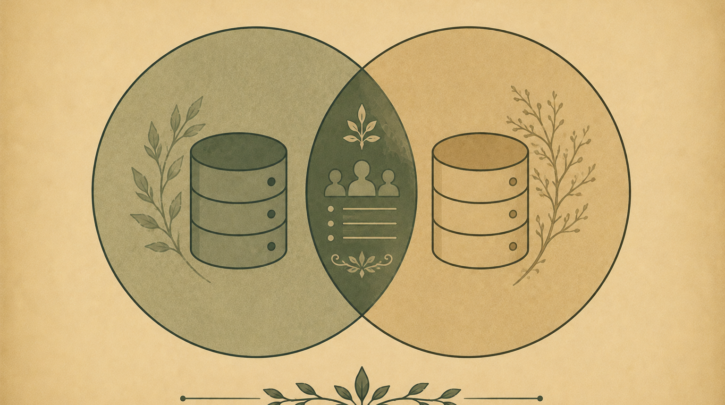
This is the practical difference to know: neither company accepts DNA uploads from other companies. MyHeritage stopped accepting them in August 2025, and AncestryDNA never did. That means you cannot test at one company and upload to the other; to be in both databases you need a kit from each. Your AncestryDNA file can still be uploaded free to FamilyTreeDNA and GEDmatch to widen your reach.
Price and records
Kit prices change often and both companies run frequent sales, so check current offers before you order. On records, the two specialise differently: MyHeritage’s SuperSearch is stronger on European records, while AncestryDNA pairs with deep US collections — which favours MyHeritage for the German side of a tree.
So which should you choose?
- Focused on European or Germany-based matches, or want a chromosome browser: choose MyHeritage.
- Researching mostly US-based German-American cousins, or want the biggest pool: start with AncestryDNA.
- Want the best of both: test with both companies, since neither accepts uploads from the other; your AncestryDNA file can still be uploaded free to FamilyTreeDNA and GEDmatch.
Whichever you pick, the matches are only the start — the real work is contacting cousins and tying them into your tree, covered in How to Find German Relatives with DNA. And if a specific paternal surname is your puzzle, neither autosomal test beats FamilyTreeDNA’s Y-DNA for that job.
Records and trees behind the DNA
Both companies are more than DNA databases — each sits on a records platform, and they specialise differently. MyHeritage’s SuperSearch is comparatively stronger on European records and has absorbed numerous European collections, which helps on the German side of the tree. AncestryDNA is backed by the largest collection of US historical records anywhere, which is invaluable for tracing your German immigrant ancestor’s American life and identifying when they naturalised. For German research you often want both perspectives: MyHeritage for the European chapter, Ancestry to document the American one.
A worked scenario
Imagine you are descended from a Pomeranian couple who emigrated in the 1880s and settled in Wisconsin. On AncestryDNA you find dozens of American cousins descended from the same couple, and ThruLines proposes how you connect — great for confirming the US branches. But none of them know the village. You also take a MyHeritage test, and there a match in northern Germany appears, with a tree naming the parish. The two databases did different jobs: Ancestry mapped the diaspora, MyHeritage reached back toward the homeland. Neither alone would have finished the job.
Which has better German region detail?
Both place you in “Germanic Europe” and subdivide Europe into many regions, and both refine over time. MyHeritage is often praised for granular European breakdowns, while AncestryDNA’s frequent updates and its “by parent” feature — which splits your estimate into maternal and paternal halves — can help you work out which side your German ancestry sits on. Neither, though, can resolve your ancestry to a German region precisely enough to replace records.
Frequently asked questions
If I can only afford one test, which is better for German ancestry?
Choose MyHeritage if you want European matches and a chromosome browser; choose AncestryDNA if your cousins are mostly American and you want the biggest pool. Remember that MyHeritage stopped accepting DNA uploads from other companies in August 2025, so being in both databases means taking both tests.
Can I move my AncestryDNA results to MyHeritage?
No longer. MyHeritage stopped accepting DNA uploads from other companies in August 2025, so you cannot add an AncestryDNA file to it, and AncestryDNA has never accepted uploads. To be in both databases you need a kit from each; your AncestryDNA file can still be uploaded free to FamilyTreeDNA and GEDmatch.
Free trial
Ready to put your research into a family tree?
Start a free MyHeritage trial to build your tree online and search historical records and other family trees as you add each generation.
Accuracy, updates, and the long game
Neither company is meaningfully “more accurate” than the other for German ancestry — they use different reference panels and algorithms, which is why the same DNA yields somewhat different numbers at each. What matters more over time is that both refine their estimates and matching as their databases grow, and these updates arrive automatically and free. So the test you take today will quietly improve, and a match who has not yet tested may appear next year. Treat your results as a living resource you revisit, not a one-time verdict, and check back periodically for new close matches on whichever platform you use.
Do my results change over time?
Yes — ethnicity estimates are recalculated as reference panels expand, and your match list grows as new people test. Both happen automatically at no cost, so it is worth logging in every few months to see new matches and refined estimates.
Ready to compare tests and current prices? See the side-by-side breakdown on our DNA Testing for German Ancestry hub, where we line up the kits, features, and what each one is best for.
A note on privacy: a DNA test shares your genetic data with a company, so review each provider’s current privacy policy before testing — who can see your data, whether you can delete it, and the rules on law-enforcement access. Policies and company ownership can change. Pricing and database figures in this article are approximate and current as of 2026.