
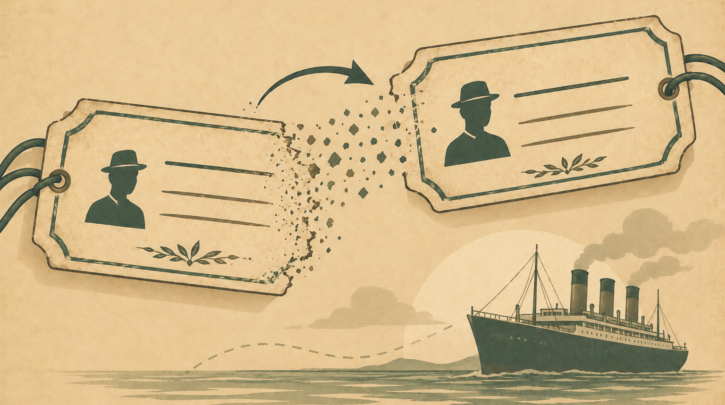

If your family name looks almost German — a Mueller, a Smith who used to be a Schmidt, a Snyder where you expected a Schneider — you are looking at the fingerprint of immigration. German surnames changed on their way into American life, and the changes tell a real story. But it is almost certainly not the story you grew up with.
The Ellis Island myth
Let us clear this up first, because nearly everyone believes it: names were not changed at Ellis Island. Immigration inspectors there did not write down immigrants’ names at all. They worked from the ship’s manifest, which had been filled out by the steamship company’s clerks at the European port of departure — in Hamburg or Bremen — when the ticket was bought. At Ellis Island the inspector simply checked the arriving passenger against that existing list, usually with the help of interpreters, and a large share of the inspectors were themselves immigrants who spoke several languages. The shipping lines had every financial reason to keep the manifests accurate, since errors meant fines and the cost of shipping a rejected passenger home.
The myth is durable — popularised by films like The Godfather Part II — because it offers a tidy explanation for a change that really did happen, just elsewhere. German immigrants changed their own names after arriving, over months and years, to fit into American life.
Not sure which record to look for first?
Get the German Genealogy Starter Checklist — the ten records to find first, and exactly which database holds each one.
How German names actually changed
Translation
Many families simply translated the name. Schmidt became Smith, Müller became Miller, Zimmermann became Carpenter, Koch became Cook, Braun became Brown, Schwarz became Black, Weiß became White, König became King, and Fischer became Fisher. The meaning survived; the language changed.
Adapting umlauts and the ß
German has letters English lacks, and immigrants handled them in predictable ways. The umlaut was either spelled out or dropped: Müller became Mueller or Muller, Schröder became Schroeder, Bäcker became Baecker or Becker. The ß became ss: Strauß became Strauss.
Phonetic respelling
Where neighbours and clerks wrote a name as they heard it, the spelling drifted toward English phonetics — Pfeiffer could become Fifer, and Eisenhauer became Eisenhower. The sound was preserved even as the spelling transformed.
Why families changed their names
The pressures were practical and sometimes painful: a wish to assimilate and be understood, easier spelling and pronunciation for employers and officials, and, especially during the First World War, the fierce anti-German sentiment that made a German name a liability. Many German-Americans quietly anglicised their names in exactly those years — part of the broader retreat of German-American identity.
How to research back to the original name
Recovering the original German form is very doable if you work the right records:
- Start with the departure manifest — the Hamburg passenger lists record the name as it was at emigration, before any American change;
- Read naturalisation papers — these often show both the old and the new name, and sometimes note the change explicitly;
- Lay census records side by side — a surname often visibly morphs across the 1880–1940 censuses;
- Check city directories — these can date when a family began using a new spelling;
- Search phonetically — think how the German name sounds and try every English rendering of it.
If you are pursuing citizenship by descent, reconciling these name changes is essential — the authorities need the chain of identity documented, as our guide to the required documents explains.
Frequently asked questions
Was my ancestor’s name really not changed at Ellis Island?
Almost certainly not there. Inspectors checked names against manifests written in Europe; they did not record or alter them. Any change was made later by the family itself.
How do I find the original spelling?
Work back through the departure manifest and naturalisation records, which preserve the German form, and search variant and phonetic spellings.
Where the change really happened
If not at the dock, then where? Mostly in the slow business of daily life: a foreman who could not spell Müller wrote “Miller” on a pay sheet; a teacher anglicised a child’s name on a school roll; a man filing his naturalisation papers chose, then and there, to become “Smith.” In American law a person could — and still can — adopt a new name simply by using it consistently, with no court process required, so most changes left no dramatic paper trail at all. They simply accumulated, which is why a family’s surname can appear to shift between one census and the next.
A worked example
Consider a Johann Müller who arrives in 1888 and settles in Cincinnati. The Hamburg departure list and his early US records call him Müller, then Mueller. By the 1900 census he is “Miller,” the name his children carry for life. Nothing was forced on him at a port; the change unfolded over a decade as the family settled in. To trace him back, you reverse the process: the “Miller” of 1900 leads to the “Mueller” of the 1890s, and finally to the Müller on the German records — which is exactly why working backward through the spellings is the key skill.
Free trial
Can’t find the arrival or naturalisation record?
Start a free MyHeritage trial to search passenger lists, naturalisation records, and census records alongside family trees, and look for the village name your German ancestor left behind.
The pressure of the war years
The anglicising trend turned into a stampede during the First World War. As German-American identity came under intense public suspicion, German-language newspapers closed, German was dropped from schools, and a recognisably German surname could cost a person work or standing. Many families chose, quietly and deliberately, to anglicise their names in those years — not at a port decades earlier, but in their own towns, under real social pressure.
Frequently asked questions
Why does my family insist the name was changed at Ellis Island?
Because the story is vivid, widely repeated in films and folklore, and offers a tidy explanation for a real change. The change was real; the location and the villain are not. Your ancestors almost certainly changed the name themselves, later.
Can a translated name be traced back?
Yes. Translations are predictable — Smith from Schmidt, Miller from Müller, Carpenter from Zimmermann — so once you suspect one, the departure manifest and naturalisation records usually confirm the German original.
Putting the research steps together
Recovering an original German surname is a matter of working every record that straddles the change. The departure manifest gives you the name at emigration; the naturalisation file often shows the transition explicitly; the run of censuses lets you watch the spelling evolve year by year; and city directories date the shift in everyday use. Read together, these sources almost always reveal both the American form and the German one — and the village along with them, since the passenger lists frequently record an emigrant’s home town. The Americanised name is not a dead end; it is the visible tip of a well-documented trail.
My ancestor’s name looks unchanged. Should I still check?
Yes — even “unchanged” names often shed an umlaut or a doubled letter, and the early records may hold a fuller German form. Always compare the American spelling against the departure and naturalisation records.
Ready to turn a surname into a family tree? The free German Genealogy Starter Checklist walks you from a family name to the ancestral town and the records that prove the line.