
Before your ancestors crossed an ocean, they passed through a port — waiting, often for days, in vast emigration halls among thousands of others making the same leap into the unknown. Two outstanding German museums now stand on those very sites and tell that story, and for descendants they are among the most moving stops on any heritage trip. Here is what each offers and how to make the most of them.
Deutsches Auswandererhaus, Bremerhaven
The German Emigration Center (Deutsches Auswandererhaus) in Bremerhaven is Europe’s largest museum dedicated to emigration. It stands at the harbour from which more than seven million people departed between 1830 and 1974, bound mostly for the United States but also for Canada, Brazil, Argentina, and Australia. The museum’s signature device is personal: on arrival you receive a “boarding pass” tied to a real emigrant’s biography, and you follow that person through meticulously recreated settings — the quayside at the moment of departure, the cramped ship’s cabins, the arrival at Ellis Island. It is history experienced from the inside, and the two or three hours pass quickly.
For descendants, the museum’s research facilities are a real draw: its emigrant database and on-site terminals let you search for your own ancestors, and commissioned research is available for deeper family enquiries. Bremerhaven sits in Germany’s north; the museum is centrally located in the city’s harbour-front “Havenwelten” district. Opening hours run roughly 10:00 to 18:00 in the summer months and shorter hours in winter, but always confirm current times and admission before you go.
Not sure which record to look for first?
Get the German Genealogy Starter Checklist — the ten records to find first, and exactly which database holds each one.
BallinStadt, Hamburg
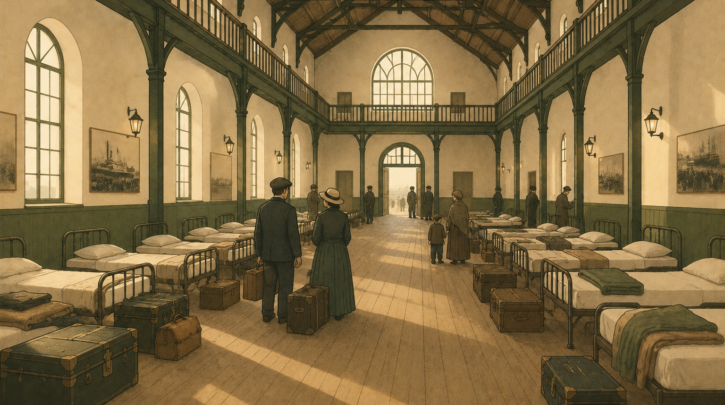
Hamburg’s emigration museum, BallinStadt, occupies the Elbe island of Veddel, on the site of the legendary Emigration Halls (Auswandererhallen) built in 1901 by Albert Ballin, director of the HAPAG shipping line. Ballin’s halls were a city within a city — dormitories, dining rooms, a church, a synagogue, and a hospital — built to house the flood of emigrants awaiting their ships. More than five million people passed through Hamburg on their way to the New World between 1850 and 1934, and the museum, opened in 2007, brings their journeys to life through three reconstructed halls, multimedia exhibits, and interactive experiences.
Like Bremerhaven, BallinStadt has a Family Research Center, and it is especially valuable for German research because it offers access to the Hamburg passenger lists — the records that so often reveal an emigrant’s home village. The museum is an easy ride from the city centre on the S-Bahn (S3 or S5 to Veddel/BallinStadt), with an audio guide available in several languages.
Which should you visit?
It depends on your ancestor’s port of departure and your route. If your family is documented leaving through Hamburg, BallinStadt connects directly to their passenger record. If they left through Bremen or Bremerhaven, the Deutsches Auswandererhaus stands on their actual point of departure. Many heritage travellers visit whichever matches their family’s emigration — or both, since each tells the story differently, Bremerhaven with greater overall depth and Hamburg with its remarkable reconstructed halls. Either way, see German Emigration Records first to learn which port your ancestors used.
The other end of the journey
To complete the story, remember the arrival side. Most German emigrants to America landed in New York — at Castle Garden before 1890 and at Ellis Island from 1892 — and Ellis Island’s immigration museum and its family-history research center are a natural complement for descendants who can visit the United States. Standing in both the hall of departure and the hall of arrival closes a circle your family opened more than a century ago.
Fitting a museum into your trip
An emigration museum makes an ideal opening to a heritage trip, framing the personal village visit that follows within the vast movement of people your ancestors were part of. Because both museums sit in the north, they pair naturally with onward travel to ancestral regions elsewhere in the country — see the heritage trip guide for how to structure it.
Doing family research at the museums
Both museums are working research centres as well as exhibitions, and for a descendant that is part of the appeal. Bremerhaven’s German Emigration Center offers terminals for searching its emigrant database and a commissioned-research service for deeper or whole-family enquiries. Hamburg’s BallinStadt runs a Family Research Center with access to genealogical databases including the Hamburg passenger lists — the very records that may name your ancestor’s home village. Arriving with your research in hand — names, approximate dates, and the port you believe your family used — lets you make the most of these facilities, and occasionally turns a visit into a breakthrough.
Practical visit tips
- Allow enough time: each museum rewards two to three hours, and the personal-biography format is best not rushed;
- Confirm hours and admission ahead — both vary by season, and prices change;
- Getting to BallinStadt: take the S-Bahn (S3 or S5) from Hamburg’s main station to Veddel/BallinStadt, just a few minutes out;
- Getting to Bremerhaven: the museum sits in the harbour-front Havenwelten district, alongside other attractions worth a combined visit;
- Bring your research so you can use the on-site family-history centres.
Other places that tell the emigration story
The two German museums are the centrepieces, but the wider story has other stops. On the arrival side, Ellis Island in New York (and Castle Garden, its pre-1890 predecessor) is the natural counterpart for families who landed there. Elsewhere in Europe, Poland’s Emigration Museum in Gdynia covers the same era from a different national perspective, of interest to those with roots in the former eastern territories. Together these sites map the whole arc of the journey, from the home village to the new world.
Frequently asked questions
Which museum is better for finding my ancestor?
The one matching your ancestor’s port. BallinStadt connects directly to the Hamburg passenger lists; Bremerhaven’s centre serves families who left through Bremen or Bremerhaven. Confirm the port first via German emigration records.
Can I research at the museums even if I do not read German?
Yes — both offer English-language support and audio guides, and staff are accustomed to international descendants. Bringing names and dates in advance matters more than language fluency.
Why these places move descendants
It is one thing to read that your ancestors emigrated; it is another to stand in the hall where they waited, to see the cabin they crossed in, to hold a boarding pass bearing a real emigrant’s name. The emigration museums work because they make the abstraction of “emigration” concrete and personal — the fear and hope of leaving everything known, compressed into a space you can walk through. For descendants who have spent months tracing dates and places, a museum visit supplies the feeling those records only imply, and it often reframes the whole family story as an act of remarkable courage.
Should I visit a museum before or after the ancestral village?
Before, if you can. An emigration museum sets the wider context — why and how millions left — which makes the personal village visit that follows land all the harder. Beginning at the point of departure and ending in the village your family left traces their journey in reverse, and it makes for a powerful emotional arc.
Trip starts with the town. Before you book anything, the free German Genealogy Starter Checklist walks you from a family name to the exact village — the one piece of information a heritage trip cannot do without.