
A surname is a thread, and pulled the right way it can lead from a name on a gravestone all the way to an ancestral village. Researching a German surname well means working through several layers — what it means, where it comes from, how it was spelled, and where it lives today — and then tying it to the records that prove your particular line. Here is how to do it, step by step.
Step 1: Find the meaning and type
Start by working out what the name means and which of the four origin types it belongs to — occupational, patronymic, locational, or descriptive. Surname dictionaries are the authority here: the Duden dictionary of German family names and the academic Digitales Familiennamenwörterbuch Deutschlands (DFD) cover names found in Germany, while the Dictionary of American Family Names is excellent for names as they appear in the United States. The type matters because a locational name may hand you a place to search, while a common occupational name will need the records to do the work.
Not sure which record to look for first?
Get the German Genealogy Starter Checklist — the ten records to find first, and exactly which database holds each one.
Step 2: Map where the name lives
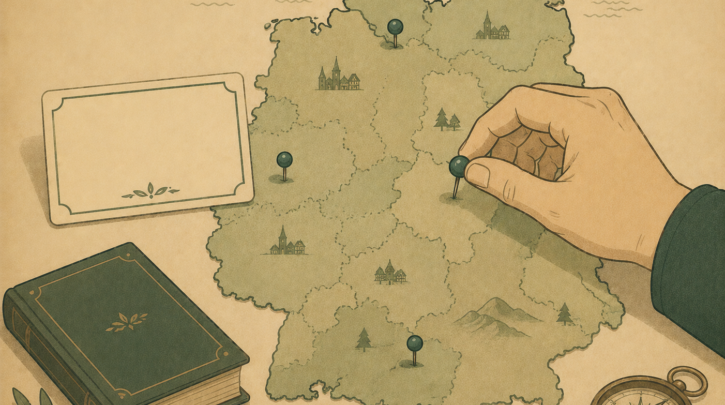
Surname distribution maps show where a name clusters across Germany today, and they are one of the most powerful tools in the kit. Geogen is the best known, plotting a surname’s frequency by district from telephone and population data. A rare surname concentrated tightly in one region is a strong pointer to the home area; a name spread evenly across the country is a caution that it arose in many places. Pair the map with the techniques in finding living relatives in Germany, where surname geography also helps locate present-day family.
Step 3: Account for the variants
Before you search records, list every spelling the name might take, because German surnames vary widely in the records — see spelling variants. If your line passed through immigration, you may also need to work back from an Americanised form to the original German one. Searching only a single modern spelling is the fastest way to miss your own ancestors.
Step 4: Connect the surname to a place and the records
A surname research project only pays off when it meets the records. If the name is locational, it may point at a village you can confirm in the Meyers Gazetteer; from there you move into the church books and civil registers that document real people. The surname narrows the field; the parish and registry records identify your family within it.
Step 5: Use DNA surname projects
For a specific paternal line, a Y-DNA surname project is uniquely powerful. Because the Y chromosome and the surname both pass from father to son, testing the Y-DNA of men bearing your surname can reveal whether they share a common ancestor — confirming or disproving connections the paper records cannot. FamilyTreeDNA hosts thousands of free surname projects, including German ones; see finding German relatives with DNA for how to use them.
Step 6: Tap the genealogy community
Finally, lean on the people who have gone before you. The volunteer network CompGen maintains surname databases and village family books, one-name studies gather everything known about a single surname, and regional forums and societies hold deep local knowledge. Our databases directory points to the main resources.
A realistic expectation
Surname research is a guide, not a shortcut. A common name like Müller will never identify your line by itself, and even a rare name needs records to confirm the connection. Treat the surname as the thread that leads you to the village and the registers — where the real proof always lives.
Frequently asked questions
Can I find my ancestral village from my surname alone?
Sometimes, if the name is locational or rare and clusters in one area — but usually the surname narrows the region and the records pinpoint the village. Use distribution maps together with passenger lists and naturalisation records.
Is a surname DNA project worth joining?
For a specific paternal-line question, yes — a Y-DNA surname project can confirm or rule out connections between same-named families that documents alone cannot resolve.
A worked research walkthrough
Suppose you start with an American surname, Bower, and a family tradition of German roots. You suspect an anglicisation, and the Dictionary of American Family Names confirms Bower as a common rendering of the German Bauer (“farmer”). A distribution map of Bauer shows heavy clustering in Bavaria, which fits a half-remembered story of southern German origins. You search the Hamburg lists under Bauer and its variants, find a departure naming a Bavarian village, confirm the place in the Meyers Gazetteer, and open its Catholic registers on Matricula. Each step — meaning, map, variants, place, records — built on the last. That is the whole method in miniature.
Free trial
Ready to put your research into a family tree?
Start a free MyHeritage trial to build your tree online and search historical records and other family trees as you add each generation.
Surname dictionaries worth knowing
Good reference works save guesswork. For names as they appear in Germany, the Duden dictionary of family names is the standard, and the academic Digitales Familiennamenwörterbuch Deutschlands (DFD) is building a comprehensive, scholarly inventory drawn from modern German records. For names as they show up in the United States — including anglicised forms — the Dictionary of American Family Names is invaluable, often giving both the meaning and the likely region of origin. Consult more than one, since they sometimes disagree on a name’s derivation.
One-name studies and the community
For a surname you intend to research deeply, look for an existing one-name study — a project that gathers every recorded instance of a single surname worldwide. Where one exists, it can save years of effort and connect you with others working the same name. The volunteer network CompGen, regional Heimat societies, and surname-specific forums and Facebook groups all hold knowledge that no database captures, and the people in them are often delighted to help a newcomer with the same name. Our databases directory is the place to start.
Frequently asked questions
What is the single most useful surname tool?
For locating a German origin, the surname distribution map — it turns a name into a region. Pair it with a good surname dictionary for the meaning and a passenger list to bridge to the emigrant ancestor.
Where do I find an Americanised name’s German original?
Start with the Dictionary of American Family Names to identify the likely German form, then confirm it through the departure and naturalisation records that preserve the original spelling.
Common pitfalls to avoid
- Trusting a single “meaning” site: popular name-meaning pages are often wrong or oversimplified — prefer scholarly surname dictionaries;
- Searching one spelling only: the fastest way to miss your own family — always work the variants;
- Assuming a shared name means kinship: common names arose independently everywhere, so confirm any connection with records or DNA;
- Stopping at the surname: the name is the start of the research, not the answer — it must lead into the village and the registers.
Bringing it all together
The strongest surname research weaves the threads into one rope: the meaning tells you the kind of name, the distribution map points to a region, the variants keep you from losing the trail, the records identify your actual family, and — for a paternal line — a Y-DNA surname project can confirm the connection. No single step is sufficient alone, but together they turn a bare family name into a documented German line, which is the whole purpose. From here, the next move is usually to fix the ancestral village and open its records.
How long should surname research take before I move to records?
Only as long as it takes to identify the likely meaning, region, and variant spellings — usually a short exercise. The surname work is preparation; the bulk of your time belongs in the parish and civil records that document real ancestors.
Ready to turn a surname into a family tree? The free German Genealogy Starter Checklist walks you from a family name to the ancestral town and the records that prove the line.