
Your German surname is a small inheritance of history. Most German family names took shape six or seven centuries ago, and they were not chosen at random — they recorded something concrete about the first person to bear them: his trade, his father, the place he came from, or the way he looked. Learning which kind of name yours is tells you something real about your ancestors, and occasionally points straight at the region or even the village you are looking for. This guide explains where German surnames come from and what yours may be telling you.
When German surnames became hereditary
Germans did not always have fixed family names. Hereditary surnames emerged in the German-speaking lands from around the twelfth century, beginning in the cities and the south, and spread gradually north and into the countryside over the following centuries. By the sixteenth century most German families had settled surnames. But the process was uneven: in the far north, where patronymics lingered, and among Jewish families, fixed hereditary surnames came much later — in several territories only by government decree in the late eighteenth and early nineteenth centuries, imposed to ease taxation and conscription.
Not sure which record to look for first?
Get the German Genealogy Starter Checklist — the ten records to find first, and exactly which database holds each one.
The four types of German surname
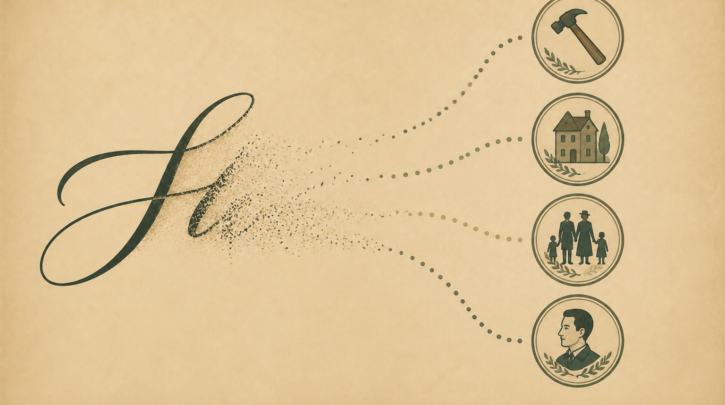
Nearly every German surname falls into one of four families, and identifying which yours belongs to is the first step in understanding it.
1. Occupational names (Berufsnamen)
By far the largest group. These named a person by their trade, and because every village needed the same handful of craftsmen, the same names arose independently across the whole country. This is why Müller (miller), Schmidt (smith), and Schneider (tailor) are so common — and why most people who share them are not related. Others in this family include Becker (baker), Fischer (fisher), Weber (weaver), Wagner (wagon-maker), Schäfer (shepherd), Koch (cook), and Schuster (cobbler).
2. Patronymic names (from the father’s name)
These derived from an ancestor’s given name, most visibly in the north, where endings like -sen or -sohn mean “son of”: Hansen (son of Hans), Petersen (son of Peter), Jansen (son of Jan). Patronymics are especially characteristic of Schleswig-Holstein, Frisia, and the Danish-influenced far north.
3. Locational and dwelling names (Herkunfts- und Wohnstättennamen)
Some names came from where a person was from, others from a landscape feature beside their home. Berliner (from Berlin), Frank (from Franconia), and Bayer (a Bavarian) name an origin; Berger (by a hill or mountain), Bach (by a stream), and Stein (by a rock) describe the setting of the home. Locational surnames are a genealogist’s favourite, because a name like “from Lindau” may point directly at a place to search.
4. Descriptive names (Übernamen)
These began as nicknames describing appearance or character: Klein (small), Groß (large), Lang or Lange (tall), Schwarz (dark-haired), Braun (brown), Weiß (fair), Krause (curly-haired). They are vivid little portraits of a long-dead ancestor.
The “von” particle
A surname beginning with von — meaning “of” or “from” — historically signalled noble lineage tied to an estate or region, much like the French de or the Dutch van. It is not an automatic mark of nobility today, and many von names simply preserve an old connection to a place, but it is always worth investigating.
What your surname’s form says about region
Because surnames developed locally, their type and form often hint at where a family came from. Müller is the most common name nationally, but Meyer dominates the Low German north, Bauer leads in Bavaria, and patronymics like Hansen and Petersen cluster in the far north. Names of Slavic origin concentrate in the east — Saxony, Brandenburg, and Lusatia, where the Sorbs still live. A surname will not pinpoint a village, but it can quietly narrow your search to a corner of the country.
Jewish surnames in German-speaking lands
Many Ashkenazi Jewish families adopted fixed German-language surnames relatively late, when required to do so by decree — in the Austrian Empire from 1787, in Prussia from 1812, and in other German states around the same period. Some are ornamental names coined at that time (Rosenberg, Goldstein), others drawn from places or trades, and many share everyday German vocabulary (Klein, Weiß) with their non-Jewish neighbours. For families with this heritage, the late and documented adoption of surnames can itself be a useful research thread, and connects to the Article 116 restoration story for descendants of the persecuted.
What a surname can — and cannot — tell you
A surname is a clue, not a conclusion. It can suggest an ancestor’s occupation, a region, or an origin, and a rare or locational name can be genuinely revealing. But a very common name like Müller tells you almost nothing specific, since thousands of unrelated families bear it, and no surname pinpoints a village on its own. The name opens the investigation; the records finish it. To go further, see How to Research a German Surname and our guide to tracing your German ancestry.
How surnames spread and became fixed
The arrival of hereditary surnames was a slow social change, not a single event. In the medieval period a person was often known by a single given name plus an informal byname — “Hans the miller,” “Konrad from the hill” — that described them but did not yet pass automatically to their children. Over generations, as towns grew, trade expanded, and authorities needed to tell people apart for taxes and property, those bynames hardened into inherited family names. The change took hold first in the prosperous cities and the south, where record-keeping was densest, and reached the rural north and remote regions much later. This is why two branches of what looks like “the same” surname can be entirely unrelated: the name became fixed independently in many different places.
Reading your surname as a clue
Once you know the type, a surname starts to talk. A locational name such as Frankfurter or Schwab quietly announces an origin — Frankfurt, or Swabia — and is worth checking against a map of where the family first appears. An occupational name tells you a trade but little about place, so you lean harder on the records. A patronymic ending in -sen nudges you toward the north. A descriptive name is the least geographically useful but the most human, preserving a glimpse of a distant ancestor’s appearance. None of these is proof, but each is a hypothesis you can test.
Free trial
Ready to put your research into a family tree?
Start a free MyHeritage trial to build your tree online and search historical records and other family trees as you add each generation.
The surname within the bigger family story
A surname is only the doorway. Knowing that yours means “miller” or “from the hill” is satisfying, but the real story lies in the records that name actual people — the baptisms, marriages, and emigration entries that turn a meaning into a lineage. Use the name to orient yourself, then move into the research proper through tracing your German ancestry and, when you are ready, researching the surname in depth.
Frequently asked questions
Does my surname tell me where my family is from?
Sometimes. Locational and rarer names can point to a region or even a town; common occupational names usually cannot, because they arose everywhere. The surname narrows the question; the records answer it.
Are people with the same German surname related?
Not necessarily. Common names like Müller and Schmidt arose independently in countless places, so most same-named families share no recent ancestor. A rare surname is far more likely to indicate a genuine connection.
What happens to a surname across the ocean
A German surname rarely survives emigration unchanged, and understanding the four origin types makes the changes easier to read. An occupational name was often simply translated — Müller to Miller, Schmidt to Smith — carrying its meaning into English. A name full of umlauts was respelled, Müller becoming Mueller or Muller. Phonetic drift reshaped others as American ears and clerks rendered them by sound. Knowing your name’s original form and meaning therefore does double duty: it tells you about the medieval ancestor who first bore it, and it helps you recognise the same name in its Americanised and variant disguises once the family crossed the Atlantic.
Can two different German surnames become the same American one?
Yes — several German names can collapse into one English form. “Black,” for instance, could render Schwarz, and other dark-associated names; “Miller” absorbs Müller and its variants. This is why you trace back through the actual records rather than reasoning from the American name alone.
Ready to turn a surname into a family tree? The free German Genealogy Starter Checklist walks you from a family name to the ancestral town and the records that prove the line.