
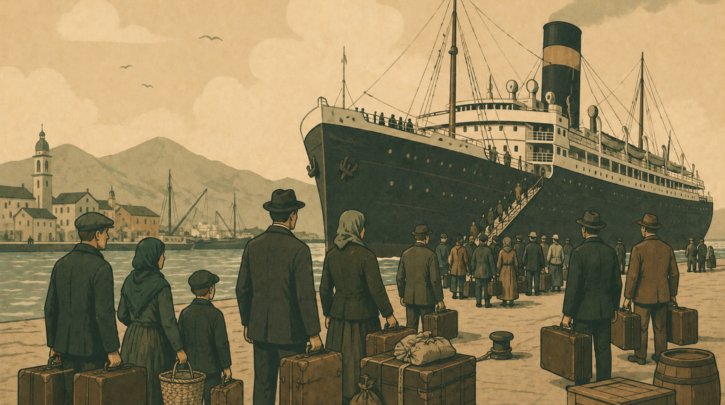

The Hamburg passenger lists are the famous emigration source, but they are not the only one — and for a great many families they come up empty, because the ancestor left through a different port. Understanding the wider landscape of emigration records, and where the gaps are, is what lets you keep going when the obvious search fails.
The great gap: Bremen
Bremen was, with Hamburg, one of the two dominant German emigration ports — and its passenger records are one of genealogy’s great losses. Bremen kept lists from 1832, but the city’s emigration office, short of storage, destroyed lists more than a few years old throughout the late nineteenth century, and most of what remained was lost in the Second World War. Only about 2,953 lists, covering 1920–1939, survive today, held by the Bremen Chamber of Commerce and indexed by the volunteer society Die Maus. For the great nineteenth-century waves through Bremen, the original lists are simply gone.
Not sure which record to look for first?
Get the German Genealogy Starter Checklist — the ten records to find first, and exactly which database holds each one.
Other European ports
Many Germans, especially from the west and southwest, left through Le Havre, Antwerp, Rotterdam, or Amsterdam. Records from these ports are sparse, scattered, or lost. As with Bremen, the practical answer is usually to reconstruct the journey from the destination end rather than the departure end.
Destination-side records
When departure records fail, arrival records carry the load:
- US arrival manifests held by the National Archives, spanning roughly 1820 to the mid-twentieth century, for ports including New York, Baltimore, New Orleans, and Philadelphia;
- Castle Garden (New York’s immigration depot, 1855–1890) and Ellis Island (1892 onward), both with free online indexes;
- Canadian, Brazilian, and Argentine arrival records for the large German communities in those countries.
Published reconstructions help bridge the Bremen gap in particular — series such as Germans to America and German Immigrants, compiled from US arrival lists, recover many emigrants whose departure records no longer exist.
Emigration files in German archives
Many emigrants needed official permission to leave, and those applications survive in German state and local archives as Auswanderungsakten — emigration files. They can record the emigrant’s home town, family members, and reasons for leaving. Coverage is regional: Hesse, Baden-Württemberg, and other states maintain searchable emigrant indexes, and local Heimat researchers have published many village emigration lists.
A search strategy when Hamburg fails
- 1. Search US (or other destination) arrival manifests to fix the arrival date and ship;
- 2. Check published reconstructions like Germans to America for a Bremen or other-port departure;
- 3. Look for an emigration permit in the relevant German state archive once you have a region;
- 4. Mine local and Heimat-society emigration lists for the home district.
Common questions
Are the Bremen lists really gone?
Almost all of the nineteenth-century lists, yes. Only a 1920–1939 remnant survives. Reconstruct from US arrival records instead.
How do I find a German state emigration index?
Start from the region your other evidence points to, then search that state archive’s online inventory for “Auswanderer” records; our databases directory links several.
The reconstruction series that bridge the Bremen gap
Because the Bremen lists are largely lost, genealogists rely on published reconstructions built from the destination side. The Germans to America series and works such as German Immigrants compile German arrivals from US passenger lists into indexed volumes, recovering emigrants whose departure records no longer exist. They are not complete and contain transcription errors, but for a Bremen-era ancestor they are often the only systematic finding aid.
US arrival manifests by era
What an arrival record shows depends on when your ancestor landed. Pre-1890 manifests (the Castle Garden era in New York) tend to be sparse — name, age, occupation, and country. From 1893 the manifests expand, and after about 1906 they often include the town of last residence, a relative left behind, and a US contact — detail that can substitute for a missing departure list. Knowing the arrival year tells you how much to expect.
Free trial
Can’t find the arrival or naturalisation record?
Start a free MyHeritage trial to search passenger lists, naturalisation records, and census records alongside family trees, and look for the village name your German ancestor left behind.
Finding an emigration permit
Many German states required would-be emigrants to apply for permission, and those Auswanderungsakten survive in state and municipal archives. They can name the home town, list family members, and even give the reason for leaving. Coverage is regional — Hesse, Baden-Württemberg, and others maintain searchable emigrant indexes — so once your other evidence points to a region, search that state archive’s catalogue for emigration files.
Newspapers and Heimat lists
Local knowledge fills remaining gaps. Regional “Heimat” researchers have published emigration lists for countless districts, arranged by village of origin, and emigrant departures were sometimes noted in local German newspapers. These village-level compilations can succeed where the great port archives fail.
Common questions
Is it worth searching German archives if I cannot read German?
Yes — many archive catalogues are searchable by surname and place, and the finding can be done with a translator’s help even before you tackle the records themselves. Our databases directory links several.
Building the journey from both ends
When departure records are missing, reconstruct the trip from the arrival side and meet in the middle. Start with the US (or other destination) manifest to fix the ship, the date, and — on later manifests — the town of origin and a relative left behind. With that town in hand, you can return to German records directly, bypassing the lost departure list entirely. The destination record often carries you the last mile that the vanished Bremen lists cannot.
Indirect clues to the port
If you do not know which port your ancestor used, a few clues point the way: families from the southwest often left via Le Havre or Bremen, those from the north and east frequently via Hamburg or Bremen, and the shipping line named on a US manifest indicates the European port it served. Narrowing the port tells you which records can and cannot help, and saves searching archives that never held your ancestor.
What if I find nothing in any passenger list?
Lean on the destination records, published reconstructions like Germans to America, and German state emigration files, and use the home district once known to search local Heimat emigration lists. A missing passenger entry is common and rarely fatal to the search.
How do I know which published reconstruction to check?
Match the series to the era and port. The Germans to America volumes index US arrivals across the main nineteenth-century decades, while other compilations focus on particular regions or ports. Our databases directory points to the major series and where to consult them.
Just getting started? Grab the free German Genealogy Starter Checklist — a step-by-step worksheet for gathering what you have, finding your ancestral town, and opening the right German records in the right order.