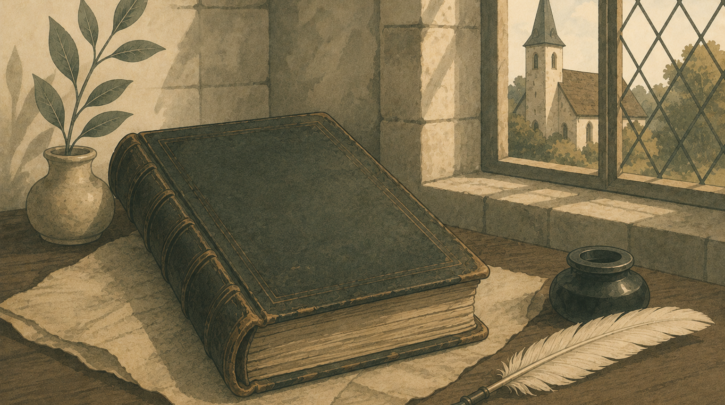

Before there were government registry offices, there was the parish. For roughly three centuries, the church books of Germany — the Kirchenbücher — were the only systematic record of who was born, who married, and who died. For any line reaching back before 1876, they are not just useful but essential, and they are often the single richest source in all of German genealogy.
What church records are and when they begin
German parishes began keeping registers in the sixteenth and seventeenth centuries. Catholic record-keeping was formalised by the Council of Trent in 1563, and Protestant parishes adopted the practice over the same period, though survival varies — the Thirty Years’ War (1618–1648) destroyed many early books. By the late seventeenth and eighteenth centuries, most parishes kept reasonably continuous registers, which is why well-documented German lines so often reach the 1600s or 1700s.
The three core registers
- Baptisms (Taufen): the child’s name and baptismal date, parents, and godparents (Paten) — godparents are often relatives and a vital clue.
- Marriages (Trauungen / Heiraten): the couple, their origins, ages or birth dates, fathers’ names, and sometimes the bride’s previous marriage.
- Burials (Beerdigungen / Bestattungen): name, date, age at death, and sometimes cause and surviving family.
Many parishes also kept confirmation lists, communicant rolls, and — most valuable of all — family registers (Familienbücher), which gather a whole family onto one page.
Not sure which record to look for first?
Get the German Genealogy Starter Checklist — the ten records to find first, and exactly which database holds each one.
Catholic versus Protestant — and Latin versus German
Religion determines almost everything about how you access these records. Catholic registers were frequently kept in Latin and are now largely digitised, free, on Matricula. Protestant (Evangelical) registers were usually kept in German, in the old script, and sit mainly on the subscription portal Archion. FamilySearch holds filmed records of both confessions. Knowing your ancestor’s religion before you start saves a great deal of wasted searching.
The family-register goldmine
In parts of southwest Germany — especially Württemberg and Baden — pastors kept Familienregister or Ortssippenbücher that consolidate births, marriages, and deaths for an entire family or village across generations. Where these survive, they can collapse weeks of page-by-page searching into a single afternoon. The volunteer network CompGen has digitised many as online Ortsfamilienbücher.
Where to find them
- Matricula — free Catholic registers for much of Germany and neighbouring countries;
- Archion — subscription Protestant registers from the regional church archives;
- FamilySearch — free, both confessions, though some images are viewable only at affiliate libraries;
- Diocesan, regional church, and state archives — for records not yet online, which is still the majority.
A reminder that applies to all of them: only a portion of any archive’s holdings is online, and coverage grows constantly, so a record absent today may appear next year. Our databases directory keeps the full list.
Common questions
How do I know which parish my ancestor belonged to?
Use the Meyers Gazetteer to find the parish that served your ancestor’s village — a single village often belonged to a parish in a neighbouring town.
The records are unreadable to me. Now what?
They are in old German script, and sometimes Latin. It is a learnable skill; start with our guide to reading old German handwriting.
How to read a baptism entry
A typical baptismal record follows a fixed structure, and once you know the shape you can extract the facts even from difficult handwriting. Expect to find the baptism date (and sometimes a separate birth date), the child’s given name, the father’s name and often his occupation and residence, the mother’s name (frequently with her maiden name, marked geb. for geborene), and the godparents. Reading entries against a known example for the same parish teaches you that clerk’s particular habits.
What godparents can tell you
Do not skip the godparents (Paten). In most German communities they were chosen from close relatives — a married sister, an uncle, a grandparent — so a baptism entry often hands you an extra branch of the family for free. Tracking recurring godparent names across a family’s baptisms is one of the most reliable ways to confirm relationships the records do not state outright.
Gaps, losses, and the Thirty Years’ War
Church books do not always reach as far back as you hope. The Thirty Years’ War (1618–1648) devastated record-keeping across much of the German lands, and fires, floods, and the two World Wars took their toll later. Where a register begins abruptly in, say, 1650, war is often the reason. When one parish’s books are lost, neighbouring parishes, diocesan duplicates, or later civil records may bridge the gap.
Free trial
Looking for your German ancestors beyond the archives?
Start a free MyHeritage trial to build your family tree and search historical records and other family trees for clues about your German ancestors.
Beyond Catholic and Protestant
While most German records are Catholic or Protestant, other communities kept their own. Jewish records were maintained by congregations and, increasingly, by the state, and survive in archives and dedicated databases; Mennonite, Reformed, and other groups kept distinct registers. If your ancestor belonged to a minority faith, look for confession-specific collections rather than the main church portals.
Common questions
How far back can church records take me?
In favourable cases, the 1600s or even late 1500s — though survival varies sharply by region and the Thirty Years’ War is a common floor. Family registers in the southwest can extend a line quickly once you reach them.
Confirmations, communicants, and other registers
Beyond the three core registers, parishes often kept others that fill in a life. Confirmation lists (Konfirmationen) place a child at around fourteen and confirm the family was still in the parish; communicant rolls record church attendance; and some parishes kept status-of-souls lists or family books that summarise an entire household. These secondary registers are easy to overlook but can bridge a gap when a baptism or marriage entry is missing.
Duplicates and second chances
Where a parish register is damaged or lost, a duplicate may survive. Many parishes were required to send copies of their registers to a higher church or civil authority, and these second copies sometimes outlived the originals. If a parish book has a gap, ask whether a diocesan or state-archive duplicate exists for those years before giving up on the period.
Are church records free to access?
It depends on the portal: Matricula is free, Archion requires a paid pass (its catalogue search is free), and FamilySearch is free with an account. Records still held only in archives may carry copying fees.
Do I need to know my ancestor’s exact parish, or just the village?
You need the parish, which is not always the village. A small settlement frequently belonged to a church in a neighbouring town, and the registers are filed under that parish. The Meyers Gazetteer names the parish for each place, which is the lookup that turns a village into findable records.
Just getting started? Grab the free German Genealogy Starter Checklist — a step-by-step worksheet for gathering what you have, finding your ancestral town, and opening the right German records in the right order.