
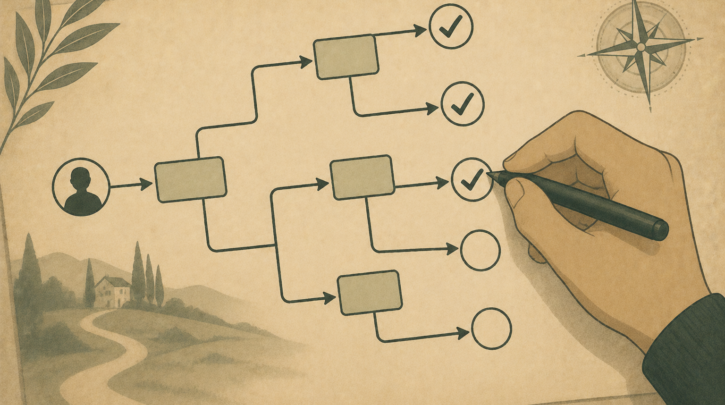

“Am I eligible for German citizenship?” is the first question almost everyone with German roots asks — and the honest answer is that it depends on a handful of specific facts about your family, most of them dates. This page walks the four routes and the questions that decide each one, so you can see which path is worth pursuing before you spend a cent on documents or translations.
Four routes, two very different categories
German citizenship through ancestry comes in three forms, all of which are rights rather than discretionary grants. None of them requires German language ability, residence in Germany, or renunciation of your current citizenship. A fourth route, naturalisation, is for people who actually live in Germany and works on completely different principles. Most readers of this site fall into the first category, so we treat the ancestry routes in depth and the residence route briefly.
Before you start, gather three facts: the birth dates of everyone in your direct German line, the date your German ancestor emigrated, and — most important of all — the date that ancestor naturalised in another country, if they ever did. Those dates decide almost everything.
Not sure which record to look for first?
Get the German Genealogy Starter Checklist — the ten records to find first, and exactly which database holds each one.
Route 1: Citizenship by descent (§4 StAG)
Ask yourself the simple version first: was one of my parents a German citizen at the moment I was born? If yes, you are very likely German already and simply need a certificate of citizenship to prove it. If your German connection is further back, the question becomes a chain of the same test, generation by generation: was your German ancestor still a German citizen when the next person in your direct line was born?
The chain almost always breaks on foreign naturalisation. If a grandparent emigrated and became, say, a naturalised American before your parent was born, the chain likely ended there — the subject of our broken-chain guide. Conversely, if your German ancestor never naturalised elsewhere (many never did, remaining permanent residents abroad), the chain may well be intact.
- Strong sign: a parent or grandparent born in Germany or holding a German passport, with no foreign naturalisation before the next birth in the line.
- Watch out for: ancestors who became US, Canadian, Australian, Brazilian, or other citizens before their child arrived.
- Also watch: the §4(4) generational cut-off for children born abroad after 1 January 2000 to a parent also born abroad after 1999 — registration within one year is required.
Route 2: The §5 declaration (historic discrimination)
German law used to deny citizenship through the maternal line and outside marriage. The §5 declaration repairs this for people born after 23 May 1949. You may qualify if any of the following describes your family:
- your German mother lost her citizenship by marrying a foreigner, so you were never able to acquire it;
- you were born before 1 January 1975 to a German mother and a foreign father;
- you were born before 1 July 1993 outside marriage to a German father and a foreign mother;
- you are a descendant of someone in one of those categories — the ancestor need not have declared themselves, only have been eligible.
The declaration is simpler than a full descent claim because you do not have to prove a flawless unbroken chain — only that you fall within a protected category. But it must be filed by 19 August 2031. See the full §5 guide for the categories in detail.
Route 3: Restoration for Nazi-era persecution
If your family fled Germany or lost citizenship between 1933 and 1945 due to political, racial, or religious persecution — including Jewish families — you and your descendants have an unlimited right to citizenship under Article 116(2) of the Basic Law or §15 StAG. There is no deadline and no generational cut-off, and each descendant holds the right in their own name, whether or not a parent or grandparent ever claimed it. These cases are free of charge and require no language, residence, or renunciation.
A common misconception is that this route requires proof of formal deprivation. It does not: §15 was created precisely to reach families who lost citizenship indirectly — by fleeing and naturalising abroad, or by marriage — or who were never able to acquire it because of persecution.
Route 4: Naturalisation (if you live in Germany)
If you actually reside in Germany, you can naturalise after five years (three years for spouses of German citizens), subject to German language ability, a citizenship test, and financial self-sufficiency. This is a different track from ancestry and is not covered in depth on this site; the 2024 reform that opened it — and the 2025 repeal of the short-lived three-year fast-track — is explained in our 2024 law overview.
A quick self-assessment
Run your family through these questions in order, and stop at the first “yes”:
- Was a parent German when you were born? → likely §4 descent.
- Did an ancestor lose citizenship to Nazi persecution 1933–1945? → Article 116(2) / §15.
- Does your line run through a German mother (pre-1975) or an unmarried German father (pre-1993)? → §5 declaration.
- None of the above, but you live in Germany? → naturalisation.
Not sure about a link in your chain? A free MyHeritage trial lets you search historical records and family trees for clues to each generation (affiliate link).
Common questions
Can I qualify under more than one route?
Yes, frequently. Families with both a clean descent line and a persecution history may have parallel claims, and the routes are not mutually exclusive. Pursue whichever is strongest and best documented.
My first read says I do not qualify. Should I stop?
Not before checking all three ancestry routes. A §4 chain that broke can still be rescued by §5 or Article 116/§15. Many people wrongly conclude they are ineligible because they only considered descent.
Myths that wrongly disqualify people
A surprising number of people talk themselves out of a valid claim. The most common false beliefs:
- “My ancestor left too long ago.” There is no general “too long ago” rule for §4 — the question is whether the chain held, not how many decades have passed. Article 116 and §15 have no generational limit at all.
- “I would have to give up my passport.” Not since the 2024 reform — and ancestry cases preserved dual nationality even before it.
- “I do not speak German, so I cannot qualify.” Language matters only for naturalisation by residence, never for the three ancestry routes.
- “Only the eldest child inherits it.” Citizenship by descent passes to every child of a German parent, not just the first-born.
Before you rule yourself out, run the family facts past all three ancestry routes rather than relying on assumptions.
What it costs to find out
Confirming eligibility is mostly a research exercise, and the early costs are modest: ordering long-form civil records and pulling census or naturalisation indexes. The larger expenses — apostilles, certified translations, and any professional help — come later, once you know which route you are pursuing and that the chain or category holds. Spending a little on records to answer the eligibility question first is almost always money well spent.
Does emigration alone disqualify my line?
No. Leaving Germany did not, by itself, cost an emigrant their citizenship. Many emigrants kept German nationality for life and passed it on. Loss generally required a further event — naturalising elsewhere, marriage, or the pre-1914 ten-year rule.
This article is general information, not legal advice. German nationality law is complex and highly fact-specific, and individual cases turn on exact dates and documents. Confirm your situation with the Bundesverwaltungsamt (BVA), your nearest German mission, or a qualified German nationality lawyer before acting. The rules described here are current as of June 2026.